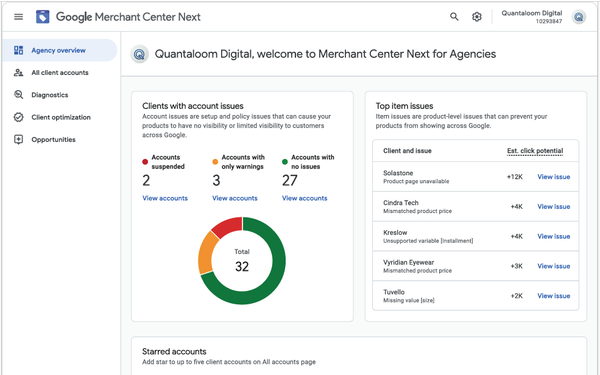
Google made Merchant Center for
Agencies generally available in the U.S. and Canada on Wednesday, by providing what the company calls a dedicated “command center” to manage an entire client portfolio in one place.
Redesigning the interface with support and feedback from agencies now enables them to bring on clients more easily as well as optimize product listings across Google to drive consistent performance
in shopping campaigns.
Agencies can manage all accounts from one interface for better time management and monitoring. It allows reps to quickly spot issues, assign tasks, and support
teamwork.
The central system also helps agency reps catch problems early to avoid suspensions, protect revenue, and maintain client trust, while identifying ways to boost client optimization
and discover ad growth opportunities.
advertisement
advertisement
Socium Media, a digital marketing agency, used Merchant Center for Agencies to establish a central dashboard to monitor and validate
promotions, inventory, and feed diagnostics for multiple clients in one interface for peak holidays. The company, per Google, achieved 50% faster resolution on tasks, and freed up time for additional
client support.
Google opened a pilot phase in late 2024 early 2025 that allowed agencies to provide feedback on features. A broader rollout began in October 2025 and replaced
complexities of the previous Multi-Client Account (MCA) system with an interface that offers "MCC-like" oversight for product feeds.
Benedek Viniczai, a performance marketer located in
Copenhagen, noticed the beginning of some sort of rollout about a month ago, noting that “this one actually matters.”
He wrote on LinkedIn that agencies managing “multiple
ecommerce accounts, this is basically Merchant Center getting an MCC-like brain.”
It shows agencies “feed issues, disapprovals and alerts across clients in one place”
without jumping from one account to another to spot problems. It gives “clearer diagnostics and prioritization, which matters before peak periods,” and it “finally treats feed
quality as a performance lever, not a technical afterthought.”