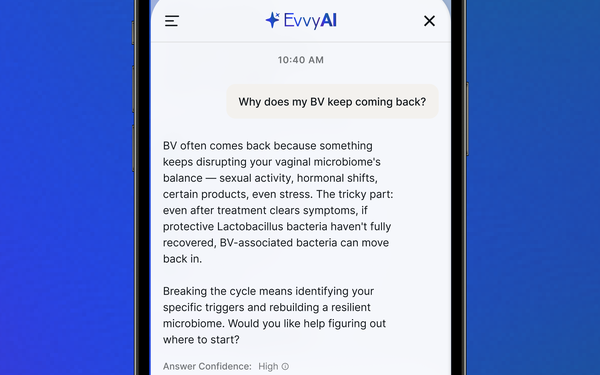
On May 19, online vaginal healthcare specialist Evvy
launched what is undoubtedly the first AI tool specifically developed to provide… you guessed it, vaginal health advice.
Evvy AI, as this advisor is called, is needed because the big AI
players like ChatGPT “get (vaginal) health information wrong,” Evvy co-founder and CMO Laine Bruzek tells Pharma & Health Insider. Why? “There’s not a lot of data on
the female body” for mass AI to cull from, she says.
“So we fed Evvy AI all of our own proprietary first-party research,” along with others’ “best research in the
space, so that women can get their answers answered in a science -backed way.”
The AI tool, Bruzek says, is available to any woman who takes an Evvy at-home test. (The provider offers
two, including a vaginal microbiome test.)
advertisement
advertisement
For Bruzek, an AI player like ChatGPT provides just another example of misinformation replacing science when it comes to vaginal health, a phenomenon
exemplified by many products in the space -- and their marketing.
Pharma & Health Insider addressed this issue with Bruzek.
This Q&A has been edited for
length and clarity.
Pharma & Health Insider: Can you elaborate on the issues with women’s health products?
Laine Bruzek: There’s a lot of promise for
things like supplements to do what clinical care should do. Women’s health is dramatically understudied, and when you compound stigma on top of that, it just gets worse. People struggle to get
the care they need. When there’s a lot of need, there’s a lot of products, many unproven, that fill the space.
A lot of times, marketing goes after that need, but not necessarily
in the correct way.
Women are being totally underserved by the medical system, and we should be innovating on products and solutions that fill those needs. But we need to do it in the right
way – with medical research, with scientific backing.
P&HI: How are other companies taking advantage of the stigma and shame that women still have?
Bruzek: By
offering silver bullet solutions that simply won’t work. Or by offering supplements masked as clinical care. For example, you’ll see supplements that will claim to cure bacterial vaginosis
(BV), the most common vaginal infection. That's not possible. You can’t cure BV with a single supplement. You need actual personalized clinical care.

P&HI: But aren’t there FDA rules about what supplement marketers can
say?
Bruzek: Yes, but that doesn’t mean everyone’s following them.
P&HI: So why does the hype so often prevail over the science?
Bruzek: The hype is the better story. But science is complex, nuanced, not an easy route to the end.
One sentence like “This type of bacteria causes infertility”
can be very definitive, but it’s not scientifically true.
Often the hype is taking a shortcut, cutting out the nuance, making very strong claims that “this causes this” or
“this will do that.” That’s hardly ever the full truth in healthcare, and not in women’s health specifically.
Figuring out how to generate the energy of things that
have hype, but with the scientific nuance, is so hard to do.
P&HI: So how does Evvy do that?
Bruzek: Anytime we are labeling something or educating, we do the long
version and make sure it’s covered from all the scientific angles. One of our tenets is to treat women like they’re smart. Don’t dumb it down, don’t cut out the nuance. Make
sure all the scientific information is presented so that we can actually do education at the same time we’re doing marketing.
P&HI: Are any other marketers in your space taking a
similar approach in terms of being science-backed?
Bruzek: We are in an amazing group of female founders in New York working across the spectrum of women’s health, from
fertility to endometriosis to breast cancer, to heart health. So many innovators in this space really care about doing the right thing because we’re women ourselves.We know we’ve been left
behind. We know there’s a lot of snake oil in this space. We’re trying to innovate to close the gender health gaps in healthcare, not to trick women.
Companies like Allara Health
and AOA DX really do care about education.
A minority of marketers, though, are taking advantage of women by using baseless claims to get their attention.
P&HI: Doesn’t
Evvy also market supplements?
Bruzek: We have one probiotic. We talk about it in terms of supporting your gut, urinary and vaginal health, and how it’s supporting your
good bacteria. We would never position it as a cure for BV – especially when we have a platform that gives personalized care for BV. We would never start with a supplement.