Consumers’ reliance on AI to choose a healthcare
provider (HCP) has more than doubled in the past year, from 17% to 36%, completely upending traditional methods like search engine marketing (SEM) and referrals from other doctors, according to a
just-issued 2026 Patient Choice Report from healthcare reputation management firm rater8.
The report found that 47% of respondents had used AI tools like ChatGPT, Claude, Perplexity or
Google’s AI Overviews to research HCPs, up from 31% in rater8’s prior research done nine months earlier.
Perhaps surprisingly, more 45- to 60-year-olds (64%) than any other age
group reported actively using AI to find HCPs. Only 28% of 18-29 year-olds did so, for example.
A possible explanation: thanks to most Google searches now automatically
triggering AI Overviews, the report states, “Patients aren’t necessarily choosing to use AI; rather it’s being placed in front of them.”
advertisement
advertisement
Not only are Google AI
Overviews growing in use, but patients are trusting them more, which directly affects SEM.
When asked which section of Google search results they trust most, AI Overviews (37%) have now
overtaken traditional organic links (20%) among survey respondents.
Online Reviews Gain Influence
The 2026 Patient Choice Report also provides evidence of the overwhelming
importance of online reviews in choosing HCPs.
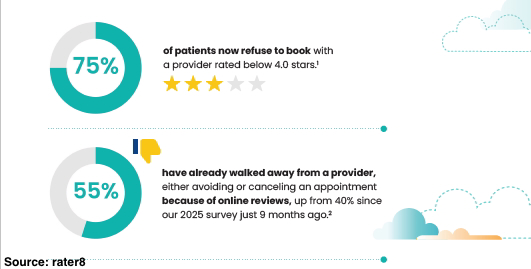
Over half of respondents (55%) said they had actually walked away from at least one doctor based on online reviews, with rater8 calling this a
“massive” increase over the 40% saying so just nine months earlier.
Three in four (75%) of respondents said they wouldn’t book with a doctor receiving below 4.0 stars
in reviews, with 44% placing the limit at 4.5 stars, and only 11% saying star ratings played no role in their decisions.
“The 4.0-star threshold creates a cliff effect for any practice
or provider rated below it,” the report states. “A practice with a 3.8 average isn’t just losing patients to better-rated competitors, but is being filtered out of consideration
altogether before any other factor comes into play.”
Also of concern to HCPs: it’s not only reviews themselves influencing patients, but how the doctors respond to those
reviews.
Nearly two-thirds of patients (66%) said that seeing a provider’s response to reviews directly influences whether they trust the provider – a 24-point jump over just 42%
saying so nine months earlier.
“The trust works in both directions, however,” proclaimed the report. “A glowing review with no response feels like a missed
opportunity, and a negative review with no response feels like an admission. A negative review answered with care, professionalism, and accountability often does more for prospective patient trust
than the negative content itself can take away.”
What’s more, “a thoughtful response to a negative review…also improves the information AI has available when it
summarizes your practice for the next person who asks.”
The report points out that the number of patients leaving their own reviews is on the rise -- only 42% of respondents said they
rarely or never left reviews compared with 56% in 2025, and 23% of patients now said they leave a review after every visit, up from 16% -- but there’s still a large gap between those who leave
reviews and those who don’t. Furthermore, those most likely to leave reviews tend to have had negative experiences,
Keeping Current Patients
As in any consumer-facing
business, doctors must be attuned to attrition as well as acquisition. In their case, rater8 found, clinical care takes a backseat to customer care.
“Front-office
friction points like ‘rude staff’ (52%) or the doctor ‘not listening’ (also 52%) are higher-stakes deal-breakers for modern consumers,” the report says, topping
sub-standard care (45%). Other deal-breakers: long wait times (41%) and billing issues (40%).
Overall, rater8 said, “for practice leaders, the implication is
direct: patients aren’t making finely nuanced judgments about clinical excellence the first time they see your reputation reflected online. They’re checking first whether you clear the
4.0-star hurdle before they go any further in their research journey. Most of what determines whether you clear that bar, from front-desk interactions to wait times to billing communication, has more
to do with how your organization runs than with the medicine you practice.”
The Patient Choice Report is based on a survey of over 1,000 U.S. patients over
age 18 conducted in April via Survey Monkey.