While gas and groceries may be
devouring family budgets this summer, Best Buy still thinks it can convince consumers that what they really need is a new TV, specifically one powered by new RGB LED technology. The bet comes as many
analysts — and Best Buy — are hoping natural replacement cycles will kick in, as the laptops, tablets, phones and smart TVs Americans stocked up on during the pandemic years begin to lose
their luster.
Best Buy and other retailers also think the new technology can create a visible enough upgrade to restart a stalled replacement cycle. But it
doesn't help that consumers have heard relatively little about it so far. Among early adopters, RGB sets made a big splash when introduced at the Consumer Electronics Show earlier this year, with RGB
Mini LED TVs from Hisense, LG and Samsung getting plenty of second looks.
advertisement
advertisement
RGB Mini LED TVs use thousands of tiny red, green and blue LEDs in the backlight to
produce color directly, instead of relying on a white or blue backlight filtered through color. Combined with local dimming — which lets each zone of the screen adjust brightness and color
independently — the technology is being marketed with brightness up to 10,000 nits in some cases, compared to roughly 1,000 nits for most current 4K content. (Nits are a unit that measures
brightness.)
While the technology isn't new, exactly, it had been limited to very expensive sets; now, in sizes starting at 55 inches, it's finally available
to a wider consumer audience.
“The challenge — and the opportunity — with TV technology this unique, it doesn't fully translate through a TV
spot or a phone screen,” says Jennie Weber, Best Buy CMO, in an email to Marketing Daily. “You need to see it for yourself, which is why the in-store experience plays such an
important role in our strategy. The entire campaign is built around the idea that RGB technology has to be experienced firsthand.”
While the TVs will be
sold in many places, the Minneapolis-based retailer has inked an arrangement making it the exclusive national retail partner for RGB LED TVs across Samsung, Sony, LG, TCL and Hisense. “We're the
only national retailer where customers can shop, compare and experience RGB LED TVs — in stores and online,” Weber adds.
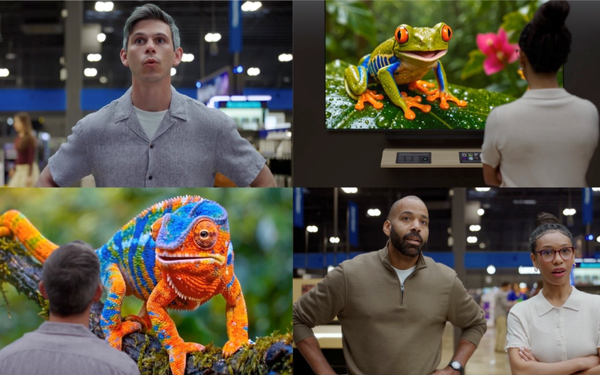
The company is running TV
ads to invite customers into stores, with spots tapping into colorful sales pitches courtesy of a laid-back chameleon for a Samsung set and an
unassuming tropical tree frog for a Sony product. The campaign also includes an exclusive tie-in to “Supergirl,” now in theaters:
through mid-July, Samsung Micro RGB TVs will reveal a hidden riddle shoppers can solve for 10 additional entries into a sweepstakes, with prizes including a trip to the Warner Bros. Archives and
Samsung Micro RGB TVs.
The full campaign spans TV, digital and social, all meant to reinforce the idea that the brighter TV color needs to be experienced
firsthand at a Best Buy. Weber says the media mix is engineered to drive awareness of the technology, "but ultimately to inspire that hands-on experience."
A
big question for these big screens — some up to 115 inches — is whether the awe-inspiring new technology is enough to make many Americans, reeling at both the gas pump and the supermarket,
inclined to spend even $1,400 on a 55-inch Samsung Class R85H, let alone $9,000 for a 98-inch Sony Bravia 7II.
Best Buy thinks many will, and not just because
this is the biggest news in TV in a decade. “We're entering a natural upgrade cycle,” Weber says, especially for people already mulling one. “More than 48 million TVs were bought
during the pandemic, and with the average replacement cycle around six years, many are starting to think about what's next.”
Observers aren't so sure.* Paul Gagnon, vice president and
tech industry advisor at Circana, says that TVs are replaced on average every 6 to 7 years, but there is a fairly large spread. Some people upgrade every 2 years, and some every 10 years. The market
research firm predicts sales of TV sets in the U.S. will rise just 1% this year, he tells Marketing Daily via email, “which is fairly typical for such a mature category.”
*Story has
been updated.