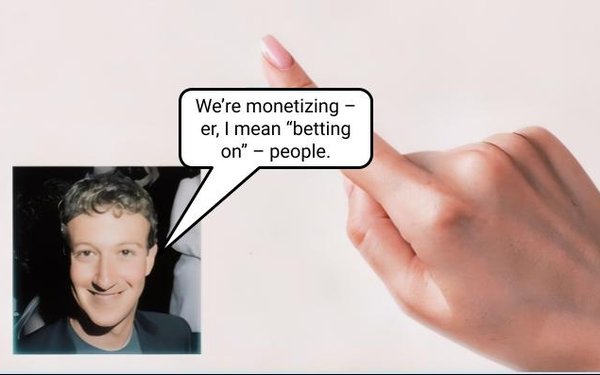
In a new spot dropped this morning, Meta says it's "betting" on us.
Based on its social media winnings to date, it's the last company I want gambling on my AI future. No matter what the odds are.
"Some people would have you believe that AI will make us less
connected. That it's gonna leave us behind," opens a new 60-second video dropped by Meta this morning. "We couldn't disagree more."
The spot, "The Future Is For Everyone," evokes some
early Apple-esque hopefulness as the narrator goes on to intone, "Call us optimists. Call us dreamers. Just as we've always done, we're betting on people."
In fact, it goes on to note
that Meta is "doubling down" on the people it has been monetizing -- er I mean, "betting on" -- repeating the refrain:
"Call us optimists. Call us dreamers. Call us whatever the hell you
want, but we're betting on people. And we like those odds."
advertisement
advertisement
You probably already know what I call Meta.
Expletive deleted aside, it has proven to be a reckless company built on
moving fast and breaking things in order to monetize the people to boost returns on its shareholders' equity.
And based on how irresponsibly it has bet on us to date -- exploiting our personal
data, using it to manipulate us algorithmically, and shirking its role as an intermediary -- it is the last company I want gambling with my AI empowered future.
That said, it knows how
to cut a 60-second spot. And how to get Ad Age to fawn over it in exchange for a scoop.
As for "Red, White & Blog," we're not so sanguine.
The spot will work, of course, in
convincing many users, investors and regulators -- probably quite a few brand marketers and agencies too -- that they're the good guys in the AI gold rush, but this is not the time to move fast and
break things that can never be fixed again.
On the bright side, the spot got me thinking not just about Meta's manifest AI destiny, but about all of Big AI Tech's.
While they
technically don't currently operate with the same kind of impunity that protects them from user liability under Section 230, they are certainly acting as if they are.
That's probably because
of the current administration's laissez faire approach to not regulating AI, because, you know, manifest destiny, the next new arms race, and oh yeah, ka-ching!
But I wouldn't be surprised to
see some new regulation and/or legislation extending the same kind of immunity from liability that Section 230 gives to telecommunications and computer networks distributing harmful content, but to AI
platforms synthesizing it.
I mean, it was just yesterday that OpenAI was sued by a user claiming ChatGPT provided life-threatening health-related advice. I expect this will be the first of many such suits.
At least
until AI platforms are given some kind of immunity.
So just like social media platforms, it's time for AI users to beware.
Personally, I think that's a good thing, because if
there was ever a time for critical thinking and skepticism, it is now.
Especially when it's some spin coming from a company that says it's betting on us.
I for one, don't
like the odds.