The Federal Trade Commission alleged in a lawsuit filed Wednesday that telehealth company Hims & Hers Health deceived consumers about both the privacy of their sensitive data
and its billing practices.
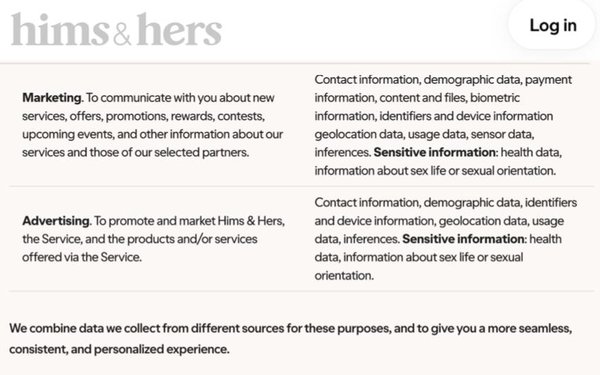
"Contrary to its privacy representations, Hims shared its consumers’ health information with advertising platforms," the FTC, along with Utah
and California, alleged in a complaint brought in San Francisco federal court.
The complaint specifically alleges that even
though the telehealth company told consumers it would not reveal health data to outside companies, it shared customer "lists" with ad platforms, and its website embedded tracking tools including the
Meta Pixel -- which can transmit information to Meta about people's online activity.
advertisement
advertisement
"In addition to advertising with Meta, Hims worked with other advertising platforms and
shared consumers’ health information with these platforms as well," the complaint alleges. "For example, Hims shared consumers’ health information with Snap, contrary to Hims’
privacy promises."
Many other allegations related to the privacy claim were blacked out of the publicly available version of the complaint.
The
complaint also alleges that the company "misled hundreds of thousands of consumers by charging them for unwanted prescription medication subscriptions without their express informed consent."
The government officials claim that Hims & Hers misrepresents that consumers can consult with medical providers about recommendations, but actually enrolls consumers into plans
that charge them for subscriptions "almost immediately" after they fill out an intake form.
"Consumers have virtually no opportunity to review the provider’s recommended
treatment, much less consent to it," the complaint alleges.
The company also allegedly makes it difficult for consumers to cancel recurring charges, in violation of a federal
law requiring businesses to offer a simple cancelation mechanism.
Hims & Hers said Wednesday in a post on
X that the lawsuit "disregards substantial evidence we provided the FTC during its nearly three-year investigation, ignores established state laws and industry standards in telehealth, and
contorts the law to try to manufacture claims."
"We are confident in our position and will vigorously defend ourselves against these baseless claims," the company wrote.
The
company also said Wednesday in a website post titled "Our Commitment to Privacy" that its practices are designed to protect
people's information.
"We separate and exclude information that patients share with their healthcare providers from marketing activity, configure technologies to prevent the
transmission of protected health information, and use measures such as abstraction and hashing to reduce identifiable information, among other protective actions," the company stated.