PubMatic has introduced an advanced governance and guardrail
architecture for its AgenticOS platform, combining technical controls with operational policies.
It offers users of the platform the ability to customize the framework to maintain human
control and auditability over autonomous AI advertising agents.
Rise, a Quad agency, is among the first agency partners to use the framework, which PubMatic describes as based on
performance and transparency in the way it governs advertising workflows.
Transparency and accountability are core to how most agencies and brands work with clients.
"As we bring
agentic advertising into our practice, those standards don't change," said Klaudia Smykowska, group director, media investment at Rise.
This type of architecture framework reflects the type of
structured and auditable approach that is needed to become more confident with autonomous media buying, Smykowska adds.
advertisement
advertisement
AgenticOS collapses the traditional programmatic advertising supply
chain. Rather than functioning as a standard piece of marketing software, it acts as an embedded structural operating system -- but not in the traditional sense, as with Google Chrome or Microsoft
Windows.
PubMatic's agentic framework uses a five-step guardrail approach at the point of execution inside the infrastructure.
The rules are embedded in the system along with
pre-approved assets, and human approval workflows are integrated into each campaign.
This gives advertisers and their agency partners a way to control the way autonomous agents execute
campaigns, and also ensures that every decision is auditable and accountable.
Similar to old software architecture models from Microsoft that allowed for easy interoperability, the
framework is designed to be configured once and work everywhere -- an important step that not only saves time, but keeps processes consistent.
When buyers first integrate with
"AgenticOS," PubMatic's operating system designed for agent-to-agent advertising, an authorized account administrator sets the organization's governance parameters using natural
language prompts to define the rules, thresholds, and approval structures that will govern campaigns.
For media buyers already operating under the Ad Context Protocol (AdCP,) the
framework runs as an independent system check, validating every transaction that touches PubMatic's platform regardless of the AI buying agent that initiates it.
When advertisers ask the
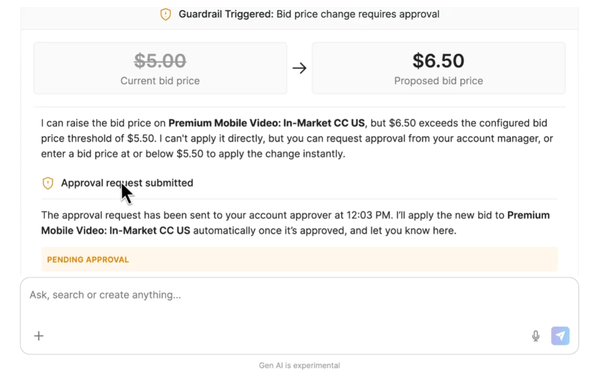
system to review campaign performance, PubMatic's assistant will identify an underperforming campaign and can recommend increasing the ad bid to find the correct optimization to improve performance.
Before making a change, the assistant will check the request against the brand's business policies. If the requested bid exceeds the brand's threshold, the assistant will explain why approval
of the exceeded bid is required to improve performance.
If a human finds the higher bid is not necessary, the bid can be adjusted to comply with the brand's policy.
AgenticOS is
intended to adapt to a company's or brand's business strategy, rather than requiring the company or the brand to adapt to AI.
The framework operates within a controlled advertising infrastructure -- such as a demand-side
platform or supply side platform (SSP) -- to check whether an ad asset or budget allocation is pre-approved before publishing.
The technology logs every decision
the agent makes, and still relies on human approval workflows to stop a campaign from going live if the autonomous agent makes an unauthorized choice.
All decisions remain accountable because
actions happen inside a closed, proprietary database owned by the agency or advertiser.
Other protocols exist that help to govern and conduct ad buying and campaign processes and protocols.
The IAB Tech Lab created Agentic Advertising Management Protocols (AAMP) as its primary umbrella framework for traditional digital advertising standards.
It relies on three main technical pillars and puts the execution layer into a container for DSPs and SSPs.
AdCP was developed through a consortium of companies including PubMatic and Yahoo. It serves as an open-source,
universal language designed for decentralized communication between AI agents.