Microsoft Advertising on Friday released an agentic
commerce blueprint to guide businesses, retailers and developers when artificial intelligence (AI) agents make purchases on behalf of humans.
Part of the plan means helping companies prepare
readable data to drive product recommendations and optimization.
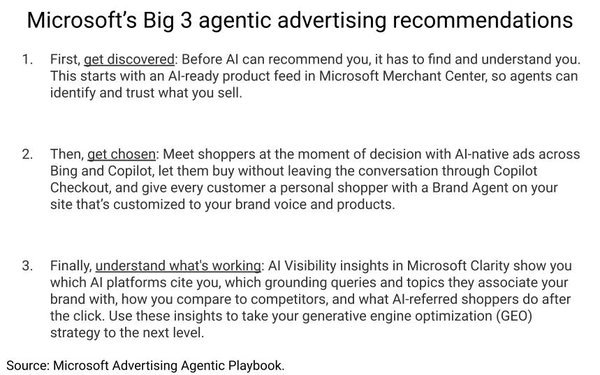
Microsoft’s "Agentic Playbook" focuses on three priorities:
- Getting discovered by the agent (which many
brands struggle with today).
- Ensuring the purchase becomes seamless.
- Having the tools to optimize performance of the intended purchase.
Part of the blueprint details a path for marketers to build a 90-day structure for agentic.
The first 45 days are about building the foundation to ensure the product feeds are ready
and that checkout is seamless.
advertisement
advertisement
The second 45 days are about using that information to optimize the content.
Microsoft unveiled the blueprint during an online briefing with marketers.
One Microsoft product marketing director on the call focused on product feeds said she can already see a major change in consumer behavior -- the way people shop.
Behavioral change,
uncertainty and experimentation continue to drive shifts in marketing and advertising, but that uncertainty also drives growth.
Bain & Company estimates the agentic U.S. ecommerce will
account for 15% to 25% of the market by 2030.
Microsoft Copilot runs on the same Universal Commerce Protocol (UCP) that many of its larger partners run on, the company said.
The
framework connects Copilot with retail, including giants like Target, Ulta Beauty, and Stripe.
UCP founding partners include Google and Shopify.
On Thursday, Microsoft
officially began rolling out "AI Max," its full suite of features for search advertising campaigns, to all accounts. It optimizes performance across Copilot Search and Bing.
The product
provides search-term matching that expands reach beyond keyword lists.
It uses keywords, ads, and landing pages, along with intent and contextual signals to find relevant searches campaign
might not reach.
It also customizes text by using a campaign’s existing assets and website content to generate and test variations on messages.
The system then selects the most
appropriate combinations at auction time.
URL expansion sends people to the page on a brand’s website that best matches their intent.
Instead of always sending traffic to a
static landing page, it can route people to the page that best matches what they seek.
With AI Max features turned on, advertisers that import existing search campaigns from Google, for
example, will seamlessly carry over into the corresponding Microsoft campaign.
Microsoft also said on Thursday it will remove “Max CPC” controls -- which states the highest price
an advertiser is willing to pay for one click on an ad -- beginning Oct. 1.
The goal is to push advertisers toward conversion-based targets and other automated bidding controls.
Existing
campaigns using Max CPC limits will not immediately lose them, while portfolio bid strategies and several other bidding strategies will retain the option.