Brands have begun to embrace AI search as an
important new part of the marketing toolkit.
Yet, at least for supplement brands, it’s not necessary to have a dedicated AI search strategy to show up in AI results, according to a
report from Content Stream, which specializes in SEO and content marketing for the health and fitness sector.
The company’s 2026 Supplement Industry SEO Report analyzes Ahrefs July data
related to 116 U.S. supplement websites, “ranging from large retailers to DTC challenger brands and established manufacturers.”
The report found that 97% of the supplement sites
studied already appear in AI Overviews or ChatGPT results, “well above what we've seen in other industries.”
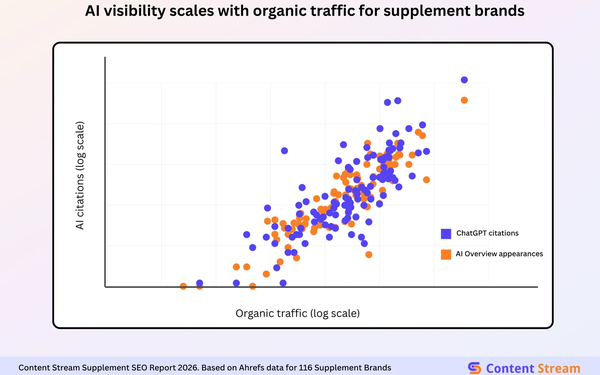
“AI visibility in this category correlates strongly with organic
(search) performance,” Content Stream found.
advertisement
advertisement
“AI visibility is a result of good SEO strategy,” the study proclaims, “and brands don’t need a separate strategy. If
you’re ranking well organically, you’re likely already showing up in AI results.”
The reason? “Content type is the most likely explanation,” the
report states. “Supplement brands rank for everyday queries—ingredients, dosages, product comparisons—that buyers in the awareness stage will ask AI chatbots.”
Debunking another myth among supplement brands, organic search can’t replace paid search.
Looking only at data from the 85 studied brands that ran paid search during the month,
Content Stream found that “paid and organic traffic grow together.”
“Brands performing best organically are also spending the most on paid ads (double that of the average
supplement brand),” the report states. “Among brands that advertise, the top 20 organic performers get 13.6% of their traffic from paid, more than double the typical site’s
(6.6%).”
“If you’re waiting for your organic traffic to get strong enough to pull back on paid, the data suggests that moment may never come,” the study declares.
“The biggest supplement brands treat both channels as a big part of their overall strategy.”Other supplement industry myths the report claims to debunk include:
Myth: SEO
content should educate first and sell second. "This is no longer true, and hasn't been for a while,” said Matthew Iyiola, Content Stream’s co-founder and SEO strategist, in a
statement. “Brands pumping out informational content are working harder, but getting fewer results." The study found that brands pushing such content as how-to-guides, ingredient
breakdowns and other educational blogs are generating nearly three times less organic traffic per keyword than brands with a balanced mix of informational, commercial, and transactional content.
“On average, the sites with a heavy informational skew see an average of 8,400 monthly visits while balanced-content sites pull in 46,900.”
Myth: Adding author
credentials and/or more informational content boosts organic traffic. The reports says its data refutes both of these convictions. While all content “needs clear attribution,”
sites with the heaviest informational skew get significantly less traffic per keyword and overall. A balanced content mix is the best approach.
Myth: A high branded traffic share is always
a red flag. “Branded traffic” refersto keywords being brand names, variations, and misspellings, Iyiola explains to Marketing Daily. The analysis found that while
there’s a problem with high branded share that’s driven by weak organic presence, “high branded share driven by strong offsite recognition is a win.” The former, the
study says, occurs mostly with smaller sites, giving nutrabolt.com (93.3%) and americanmetabolix.com (100%) as examples. On the other hand, “top supplement sites get 80% of their
traffic from non-branded search.”
Among the 20 lowest-traffic sites, branded search accounts for 54% of their overall traffic, the report found, while the figure among the 20
highest-traffic sites is only 20%.