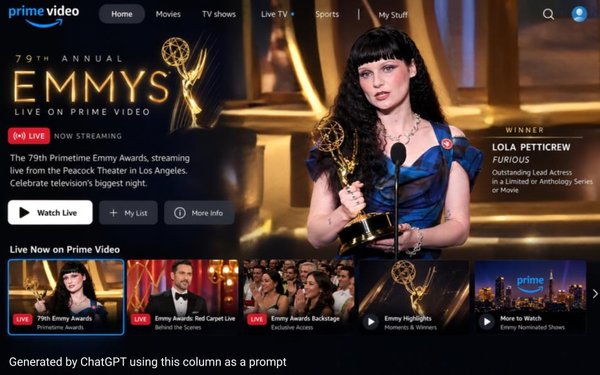
The Primetime Emmy Awards, which have been
an annual staple of broadcast television since their inception in 1949, are migrating to Amazon Prime. But is this necessarily a bad thing for legacy networks?
The
news broke on Wednesday: Amazon Prime has obtained the rights to the Primetime Emmys from the Television Academy for the next six years, starting next year.
Terms of the deal were not disclosed. Variety estimated that six years of Emmy rights, both foreign and
domestic, are worth $90 million, while Deadline said this was worth $120 million.
Whether the
annual cost is $15 million or $20 million, the price is not extravagant.
advertisement
advertisement
By contrast, in 2025, YouTube paid
an estimated $100 million per year for five years of rights to the Oscars, starting next year.
In 2024, Disney paid an estimated $500 million for 10 years of
Grammy rights starting next year.
In the sports arena, some NFL games have gone exclusively to Netflix and Amazon Prime.
Under its current three-year rights deal with the NFL, Netflix is paying an estimated $75 million per game.
In 2023, Amazon Prime struck a 10-year rights deal with the NFL that was reportedly valued at $1
billion.
NBCU’s 11-year deal with the NBA is said to be worth $2.5 billion a year. Under the deal, NBA games shown on NBC are also seen simultaneously
on Peacock. Other games are seen exclusively on Peacock.
These deals in recent years are rightfully considered part of an ongoing migration of big-ticket
live events to streaming that have been tentpole attractions for legacy TV for decades, even if some of the events -- such as NBC’s NBA games -- are still seen on network TV.
Even Disney’s acquisition of the Grammy rights can be seen as a streaming play. The awards are headed to ABC, but also to Disney+.
The aforementioned are all big events attracting big money. But is the migration of the Emmys to streaming the same thing?
The answer is no -- for the simple reason that unlike these other rights that cost in the billions and hundreds of millions, the Emmy rights were available for a song and
none of the legacy networks stepped up to keep them on network TV.
Over the last few years, the Emmy telecasts have been ratings losers. But even more
importantly, for years now, network television has lagged way behind the streaming services in nominations and wins.
Because of this imbalance, the Emmy
Awards on network TV have become a three-hour, prime-time festival of promotion free of charge for the streaming services and their shows.
Once upon a time, the annual awards show seen on network television was a three-hour promotional platform for itself.
The TV Blog has noted this phenomenon before. “Each year in September, one of the four broadcast networks gladly and without reservation devotes three hours of
precious prime time to embellishing the reputations of shows seen elsewhere, whose renown and popularity contribute to the erosion of network audiences,” said the TV Blog in
2022.
“This incredible opportunity for priceless prime-time promotion is the annual Emmy Awards, in which the networks’ competitors, pay cable
and streaming services, get to strut their stuff for free,” the blog said
Times change, and so does the television business. The Emmys on network TV
have outlived their usefulness.