Google's partnership with Unity Software, announced
Wednesday, brings artificial intelligence (AI) into the next evolution of gaming. The move could give marketers expertise as content creators.
The two companies will develop an AI-powered
gaming platform. The AI will guide creators to better understand what's needed to build an interactive game.
advertisement
advertisement
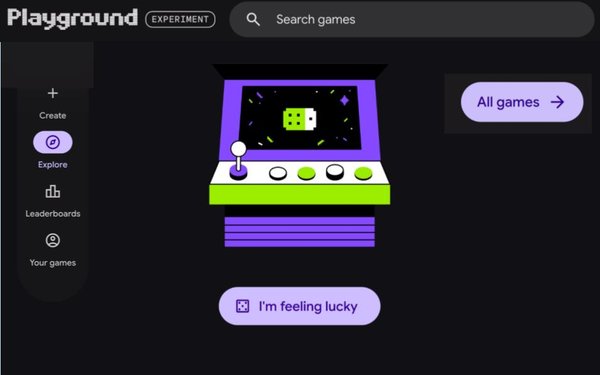
Playground, Google’s
experimental new platform available today, is a broader consumer product that allows users 18 years old and up to generate and customize playable games using natural-language prompts, with no coding
required.
Playground will integrate with Unity’s software to launch a professional-level gaming interface later this year. The platform, Unity Spark, will feature high-fidelity 3D
capabilities and the Unity runtime as a web-based collaborative platform, allowing creators to build simple concepts to complex experiences.
Speaking with CNBC, Unity CEO Mathew Bromberg said
the idea is "reduce the complexity of making games" with AI, which should open the possibility of becoming an interactive content creator to "tens of millions" of people.
About 70% of
the top 1,000 mobile games worldwide are made on Unity Software, according to CNBC.
"Gaming is a complicated art," Bromberg said, adding that the goal is to build the platform once for all
types of devices. "It balances art and science. It's deep in tech. You have to think about level design, sound, and the user interface."
The platform will start with being available for
mobile gaming, and then move to the web and on to the PC and consoles.
Google provides the technical expertise and massive distribution through Playground.
Gaming sits in Google DeepMind's DNA. Demis Hassabis, one of Google DeepMind's founders and now chairman, is a former game developer with many years of hands-on experience and a
deep respect for the craft of making games, according to research released
in August.
Since DeepMind’s founding in 2010, games have played a critical role in understanding AI intelligence, driving some of the biggest AI breakthroughs --
from mastering Atari to helping solve protein structure prediction.
The research paper provided hints at Google's future with gaming by detailing how far DeepMind has come with structuring AI
for games.
AlphaGo, an AI system, learned to master the ancient Chinese game of Go, a complex board game of strategy. AlphaGo Zero surpassed every previous version
by learning entirely from self-play, with no human data. It generalized this approach to master chess, shogi, and Go with one algorithm, while MuZero learned to play without even knowing the rules. In
2019, AlphaStar, another AI structure, reached Grandmaster level in "StarCraft II," navigating real-time complexity and imperfect information.
"We are aiming for
the same ultimate goal we always have: AI as a catalyst, not a replacement," according to the research paper. "Our long-term ambition is to unlock breakthrough gameplay experiences, make games more
accessible and more personalized, and — as we've seen from AlphaGo to AlphaFold — apply what we learn in games to problems in the real world and to advance scientific discovery."