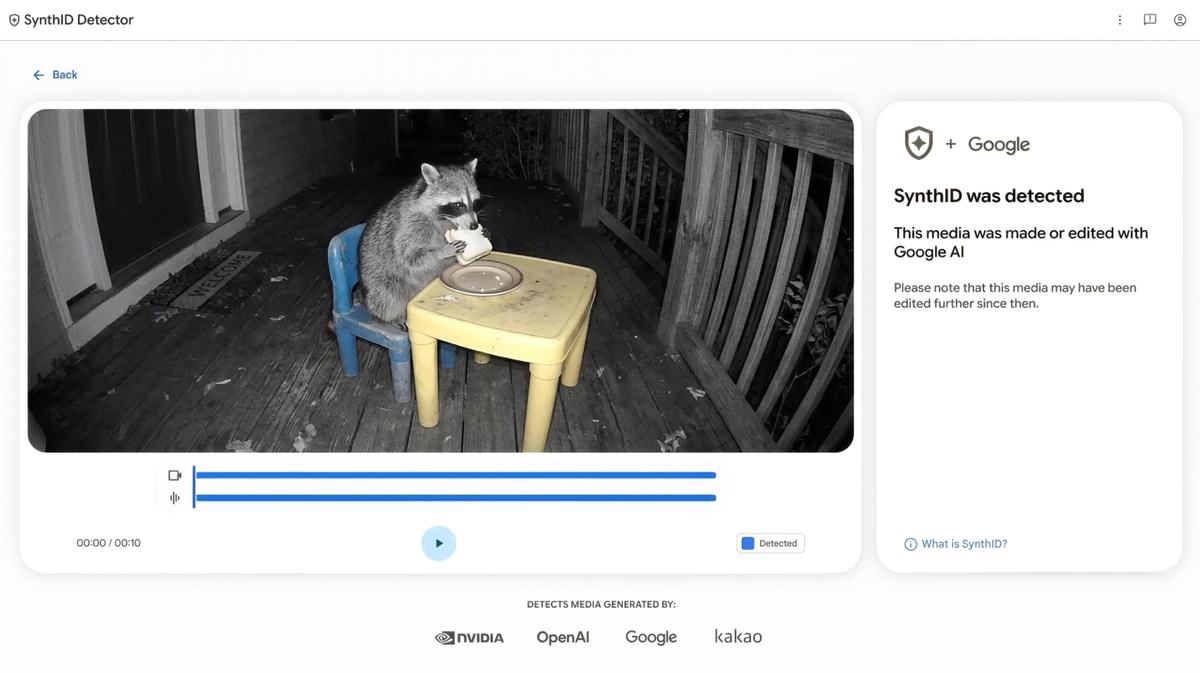
Google on Wednesday launched a new site that lets anyone verify if content was produced using AI.
SynthID Detector has helped media professionals verify AI-generated content since
the launch of the watermark in 2023. Now, Google expands access to everyone, making the tool available globally in English starting today.
In programmatic media buying, relying blindly
on AI detection can expose campaigns to severe risks, so understanding the loopholes becomes just as important as using the technology to build resilient media-buying frameworks.
Google introduced SynthID to identify AI-generated content, and since its inception has watermarked more than 180 billion images and videos. The company’s Nano
Banana, Veo, and Lyria models, as well as tools with generation capabilities, like Gemini, Flow, ProducerAI, and Vids, all use SynthID to watermark any media generated through these platforms.
advertisement
advertisement
This tool joins Google's verification features in Search, Gemini app, and Chrome, which now regularly process more than 1 million requests daily. It has been adopted by Nvidia,
OpenAI, and Kakao.
SynthID is integrated across a growing ecosystem of models on a list that continues to grow as more AI organizations adopt watermarking process. It is embeds digital
watermarks directly into AI-generated images, audio, or video. For each modality, SynthID's watermarking technique cannot be seen by humans. The tool aims to build more reliable system to help people
make informed decisions about how they interact with AI-generated content.
The SynthID Detector checks uploaded media for a watermark in the content. It also
acknowledges when one is not detected -- which doesn't totally rule out AI generation or manipulation, Google stated in a Q&A on the website.
Still,
AI-generated content may not be detected if it was created by a model without SynthID, or if the watermark has been heavily modified. The technology's detection capabilities have two main
limitations: lack of complete universal adoptions, and vulnerability when the content is heavily modified. In very rare cases, SynthID can trigger a false positive notification of being AI-generated
for non-watermarked content.