It ranked as one of the stupidest ideas
of President Trump’s second term, but now, the plan to livestream the execution of the Fort Hood shooter who killed 13 people in an unprovoked attack in 2009 has been nixed by Trump himself.
But the fact that this idea got as far as it did defies belief.
The plan to
livestream the firing-squad execution of Nidal Malik Hasan was announced, in all seriousness, by Secretary of Defense Pete Hegseth earlier this month.
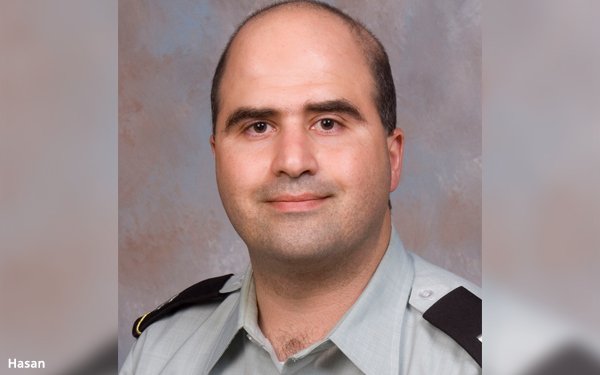
Hasan,
a one-time U.S. Army psychiatrist who held the rank of major, killed 13 people and injured 32 others when he went on a shooting spree at Fort Hood, Texas in 2009.
The Pentagon has set an execution date for Hasan -- Dec. 3 -- and planned to make the execution available to all Americans via livestream.
advertisement
advertisement
“We’ll make sure that people are able to watch it, that it’s public,” said Hegseth in an interview on Oct. 8. Later, it was learned that President Trump was
wholeheartedly in favor of the plan.
But on Thursday morning, Trump backed off. He sent his regrets to the world on TruthSocial.
The public execution “might have been a strong deterrent for the World to witness how America deals with Terrorists and SCUM like Hasan,” Trump
wrote.
Thanks to Secretary Hegseth and President Trump, the United States almost became a country that holds public executions. Hmm, kind of like
Iran.
Critics of the plan have been pointing out that preserving the execution for all time by making it available online would only serve to elevate
Hasan to martyr status in the global community of Islamist jihadists.
His shooting spree is classified as a terrorist act. He opened fire after shouting
“Allahu akbar!” (“God is great!”).
So, given everything that is permissible now on TV and the internet (which is
basically everything), why not offer a live look-see at this execution too?
Thanks to TV and movies, our culture makes it possible to consume thousands
of scenes of extreme simulated violence every day. Why should a televised execution be any different?
Because simulations are one thing. Live
broadcasts in which cameras and lights are set up in an execution chamber are another.
The decision to provide live coverage of this firing-squad execution
was an example of doing something for which there was no need.
Unless I’ve missed something, there did not seem to be a groundswell of interest
in watching this execution either on line or on television.
It is doubtful that the sight of a death by firing squad would have had fanatics thinking twice
about committing acts of terrorism.
Was it for the benefit of the American people? If so, it is difficult to see how Americans would have benefited from this
(hopefully) once-in-a-lifetime opportunity to witness an execution.
Capital punishment is a divisive issue. Those who are against capital punishment would
have used used the video to demonstrate the barbarity of the practice.
Those who are for capital punishment would have said the practice is justified in some
cases depending on the severity of the crime, and that this is one of those cases.
This plan to essentially broadcast this execution revives memories of
another instance years ago in which the televising of an execution was discussed, and almost happened.
The convict facing execution was Timothy McVeigh, who
carried out the 1995 bombing of a federal building in Oklahoma City that killed 167 people (19 of them children) and injured 684.
Based on the notoriety of
that crime, a company called Entertainment Networks Inc. proposed to carry the execution live on pay-per-view for the low price of $1.95 or $2.50 (amounts differ on the internet) per
household.
The company filed suit against the Federal Bureau of Prisons for the right to carry out this plan, but a U.S. District Court judge in
Indiana ruled against it. McVeigh was executed by lethal injection in June 2001.
If memory serves, the judge’s decision was just part of the reason why
the live execution never went ahead.
The other was a sense of general revulsion on the part of the public.
In today’s anything-goes culture,
it is possible to wonder whether general revulsion is even a thing anymore -- especially when mounting a live execution in the manner of a Roman circus is endorsed by the President of the United
States.
This column has been updated.