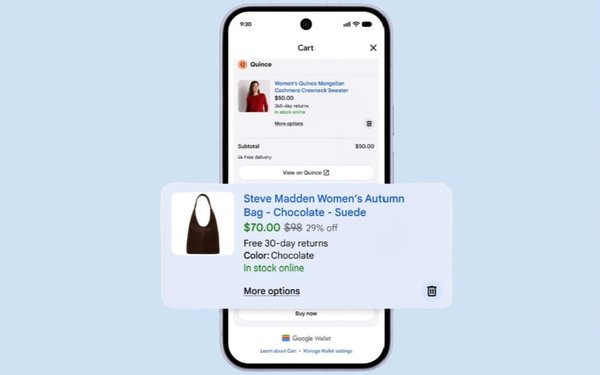
Google has begun rolling out "Universal Cart"
Thursday in time for the holidays after providing details at its annual Google I/O developer conference in May.
The agentic commerce and checkout tool is built on Google’s Universal
Commerce Protocol (UCP), co-developed UCP with Shopify, to enable artificial intelligence (AI) agents to communicate with payment infrastructures in ecommerce transactions.
The
tool, an intelligent shopping cart designed to serve as a shopping hub on Google, uses Google Search data and AI-powered item organization, is being introduced in the Gemini
app.
The cart saves the consumer’s list of items in the cart. It can organize the shopping experience, track items across retailers, keep the user informed about promotions, and
checkout with all items.
advertisement
advertisement
While the cart mirrors how people shop today across Google Search and AI engines, Universal Cart changes ad targeting and where the data sits. When a consumer abandons
a cart using this system, it changes the retargeting landscape for advertisers in several major ways.
Previously, a consumer went to a retailer’s website, put items in the cart and, for
various reasons, closed the browser window.
Now, each time a consumer saves a product to Universal Cart via AI Mode in Search or the Gemini app and then closes the browser window or app, the
products remain when the user returns, but that data sits in Google’s ecosystem.
Products left in the cart shifts control of retargeting and cart-abandonment data away from the
retailer’s independent site, however, and moves it into Google’s advertising ecosystem. It’s not clear if the ownness remains on Google or retailer to trigger a retargeting ad to the
consumer for the products left in the cart.
The retailer legally retains full ownership of the customer data, transaction records, and post-purchase
relationship. Google's Universal Commerce Protocol (UCP) Guide states that merchants remain the Merchant of Record, ensuring
they maintain control of their first-party data and customer lifecycle.
However, industry analysts warn that the actual dynamics of data ownership with Universal Cart can become highly
nuanced.
Google’s cart supports more than 60 billion continually refreshed product listings via Google’s Shopping Graph. Consumers can get notifications about price drops
or restocks because Universal Cart continually checks in the background.
Debra Aho Williamson, founder and chief analyst of Sonata Insights, said she will not be surprised to see some
retailers offer deals or special promotions to encourage consumers to try agentic shopping.
“Both approaches will reveal a lot about the future role of agents in shopping, the types of
purchases consumers are and aren’t willing to delegate, and how seamless (or not) the handoff will be between consumers, retailers and payments systems,” she wrote in a newsletter
published today.
Retailers need to register to participate in Universal Cart. Nike, Sephora, Target, Ulta Beauty, Walmart, Wayfair, and many Shopify merchants have already signed up. They were
announced in May when the pilot launched.
Merchants can either enable checkout within the cart or give shoppers the option to transfer products to a pre-loaded cart on the retailer’s
site. Some support both.
In PYMNTS Founder and CEO Karen Webster's analysis, Google's Agentic Wallet: Is the Fifth Time the Charm?",
she breaks down the architecture behind Google's UCP and the Agent Payments Protocol (AP2) to address Google’s exact technical framing before introducing the caveat around data ownership.
"Google says merchants keep their customer data," she writes. "Technically true. But neither the merchant nor the issuer sees the intent data that preceded the transaction. Google sees it
all."