Neuro-contextual ads deliver 3.5x higher
neural engagement than non-contextual ads, a 26% positive lift in responses, and 30% higher than standard IAB contextual ads, according to findings from Seedtag research.
The global
neuro-contextual advertising company conducted the neuroscience study in partnership with Professor Moran Cerf, a neuroscientist at Columbia University.
“Brain alignment is the currency
of great content,” stated Cerf. He believes the study's findings prove that when the emotion of an ad matches the emotion of its environment, the brain works less and remembers more.
Neuro-contextual ad placements are a form of ad targeting that uses AI and neuroscience to understand deeper signals like interest, emotion and intent, moving beyond traditional contextual
methods.
The use of neuroscience-trained artificial intelligence (AI) is an emerging trend in the industry, and other companies are developing similar advanced contextual-targeting
capabilities. Seedtag is not the only company to use this approach, but has positioned itself as a “leader” in this space.
advertisement
advertisement
Others using this approach include GumGum, Cognitiv,
and Anoki, and Peer39, according to Google AI Mode.
The assumption is that mobile neuro-contextual ads drive higher attention rates. Seedtag’s latest study found its approach delivered
3.5x higher neural engagement vs. non-contextual ads, more than 30% lift in neural engagement vs. standard contextual ads, and a 26% increase in positive, action-driving emotional response.
The findings suggest that advertising effectiveness is strongest whe ads are matched to an article’s dominant interest, intent, and emotional tone.
The research suggests that
planning decisions grounded in emotional and cognitive signals, rather than surface-level categories or keywords, can improve audience receptivity and reduce cognitive friction.
Neuro-contextual alignment provides a way to identify moments when consumers, or audiences, are more open to engagement.
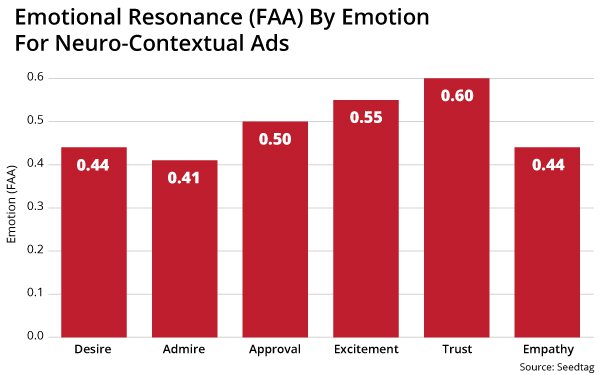
Do neuro-contextual ads increase left-side alpha brain activity?
Findings from the study suggest they do. This left-side alpha brain activity governs emotions that drive engagement, generating a 26% increase in positive, approach-oriented emotions over standard
contextual ads.
The white paper, titled “Tapping Into the Brain’s Design: Neuroscience and AI for Real Human Connection,” can be found here.