AI agents can scour the web one thousand times faster than a human
to find information on products and services. This is prompting brands and retailers to make a fundamental ecommerce shift.
“It’s painful to watch an agent try to do a search
through a traditional engine and search bar, which uses keywords, not natural language,” said Jonathan Arena, co-founder of New Generation, a technology startup building a new
ecommerce infrastructure for the AI internet. “It must go from page to page or product to product to try to find the answer to the customer's question.”
A test
conducted by New Generation with retail brand Williams-Sonoma compared searches through traditional and agentic technology and confirmed the variance.
The human asked the question “what
is the best brand of Japanese knives to give to a foodie friend for a holiday present?" It took the agent 11.5 minutes to answer a simple question using a traditional search bar.
advertisement
advertisement
New
Generation is attempting to build a type of business model where the code sits in the underbelly of the internet used only by AI agents -- a place consumers do not go or see. There agents can access
the information in less time to answer questions and fill consumers' requests in much less time -- all within seconds.
Agentic agents will scour the code, while consumers will go to
traditional websites. It harkens back to the days of Google’s mobile first theory, when brands and retailers had to build mobile websites to support desktops. Now they will need to build agentic
websites to support AI agents.
By the 2026 holiday season, Arena said consumers will spend much less time buying gifts and more time enjoying the holidays.
“Two years from now
you should be able to tell an agent to build a Christmas or a holiday shopping list from my top favorite brands that the consumer typed into a list and provide a list of people to buy for,” he
said. “In five seconds, the agent will have found the gifts and assembled a shopping cart.”
It makes sense that agents should have a different way to access websites. Personally, I
would feel safer, in terms of protecting my data, if I didn’t need to use the same site as agents.
For this to work, consumers and merchants must trust that agents do not scour
websites and scrap products and personal data.
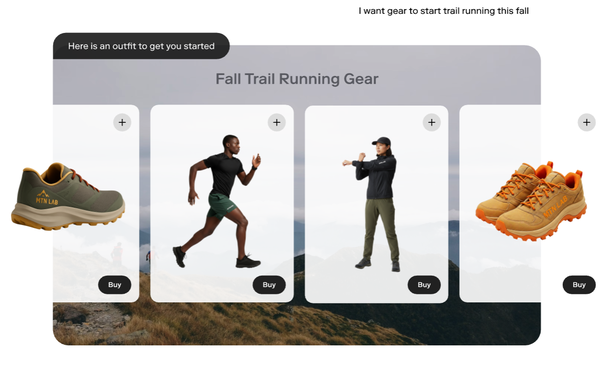
Many companies have been thinking about ads in agentic models, Arena said.
“I think it’s reasonable to assume many companies
are thinking about this. Our company is thinking about agentic ads as a way to drive traffic to websites -- pay traffic versus organic traffic,” Arena said. “Someone will invent a
different ad format.”
Facebook, Arena said, “famously came up with one of the best ad formats for its feed, a vertical scrolling feed mixed with content from friends.”
That was a real innovation in ads, Arena added, and they performed exceptionally well from the start.
“A new type of agentic ad will need to feel native for long-form type of
conversation when doing product research or shopping in an LLM,” he said. “It will need to be something like sponsored results or sponsored storefronts that are rendered for you. It
won’t look like any ad like today, but it is still will be placement or paid traffic routing to an entity that’s owned by the advertiser.”