For decades, the Super
Bowl has been advertising’s most expensive — and most scrutinized — stage. But in 2026, the Big Game is also the opening ceremony for an unusually dense and high-profile sports year
for U.S. fans, justifying extra-big spending as brand messages flow right into the Winter Olympics, the FIFA World Cup, and an expanding universe of streaming-led sports coverage.
That
convergence is changing how brands approach Super Bowl advertising and how they are measuring their success. Instead of betting everything on a single in-game moment, marketers are stretching Super
Bowl investments across weeks of pre-game drops, digital extensions, streaming buys and AI-powered personalization that extend well past the fourth quarter.
To unpack what’s shifting
— and what will matter more than which spots people are buzzing about Monday morning — Marketing Daily spoke with Nicole Greene, vice president and analyst at Gartner.
advertisement
advertisement
This interview has been edited for length and clarity.
Marketing Daily: Tell us why the Super Bowl feels bigger this year.
Nicole Greene: What’s unique is
that we have the game, and all the usual conversations about which ads will be winners, but this is kicking off a very high-profile sports season. Even if some ads don’t make a big impact in the
Super Bowl, marketers have the opportunity to take all of that, including the PR machinery, and extend it right into the Olympics. Both are on NBC this year, and there are so many streaming
possibilities. Then the World Cup is coming up, on top of the usual basketball season. So the sports ecosystem is especially rich this year.
And we are in this moment where the world is
volatile. That means there is an opportunity, not just to sell stuff, but to build trust, and do it in a relevant way.
Marketing Daily: Sports-pocalypse aside, do you think people are
in the mood to trust brands right now?
Greene: People don’t trust brands, and they don’t trust AI. Our research backs that up. That’s why it’s becoming such an
important part of customer-centricity. Marketers need to ask, “Did this ad help us increase brand trust?” As AI becomes more omnipresent, trust matters even more.
Ads that can do
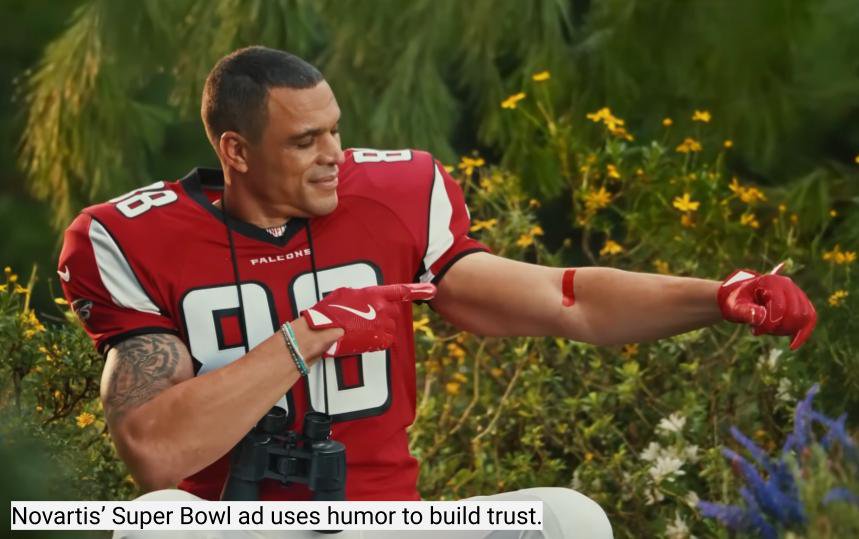
that — connect with sports, in the moment and build trust — will be among the most memorable. I’m betting that the Novartis
spot, for example, which uses football players to talk about cancer screenings, will be one that really resonates.

Marketing Daily: Say more about how AI will figure into the game, both
in ads and in game-day conversations. Claude takes a direct swing at ChatGPT, so that will get noticed — but how much do
consumers care about AI in ad use itself?
Greene: They care a lot. These tech giants hope you’ll be talking to all your friends about how you use AI in your daily life, because
they want your trust so they can monetize their users. We have a lot of research on the ways consumers don’t trust brands or AI, so this is a pivotal moment — tech brands need to be
proactive.
Many companies use AI in an overt way, especially in visuals, like putting a car on Mars, or in last year’s game, changing Seal’s head to a seal. It’s completely
fabricated and consumers are largely receptive. It’s humor, and entertainment.
And they’re also fine with giving companies data so they can get emails with tailored offers. But
that’s different than saying, “Give me your data so I can train an LLM to upsell you.” People want transparency, and they don’t like to be tricked. Gartner research shows that
79% of consumers say it’s very important — or the most important thing — that brands explicitly label AI usage in the content they publish.
Marketing Daily: But
it’s gotten close to impossible to tell what is AI-generated — even by experts.
Greene: That makes transparency even more important. Right now, brands need to be very open
about their use of AI. That may evolve as people get more comfortable, but at this moment, trust is fragile.
Marketing Daily: Besides Novartis, which ads do you expect to get the most
buzz?
Greene: History repeats itself, so I’m counting on nostalgia and Americana. I think all of us are craving connectivity and connection right now, embracing the fact that the
Super Bowl isn’t just sports, but a cultural moment of happiness. Everyone gets together, eats lots of food and has a good time. You’re going to see a lot of those ads do well. Food is
such an important part of the Super Bowl. And always, celebrities.
Marketing Daily: What are the lessons for CMOs who don’t have a Super Bowl budget?
Greene:
Ruthless customer-centricity. Customer journeys are essentially collapsing into AI-generated experiences right now, so when you do have the opportunity to reach your customer, you need to make sure
you’re delivering a relevant message. That means being more disciplined, more precise in the messaging — that’s about sequencing and intent. Know what you want them to do. And
deliver messaging that reflects their actual journey.