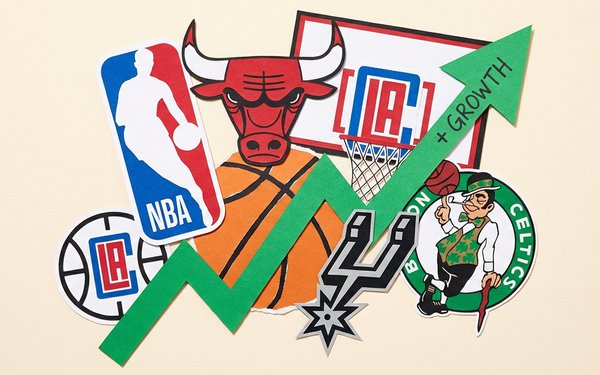
Valuations of NBA teams have been skyrocketing --
and TV revenue is a major reason why.
We can thank rising sports rights fees -- now at $75.9 billion over 11 years, up more than two-and-a-half times the previous contracts -- by way of major
TV advertising and sponsorship revenue.
A collective $637 million in regular-season TV advertising for the 2024-25 NBA season was pulled in, according to EDO Ad EnGage, followed by $845
million for all post-season media buys.
The big three advertising categories include quick-service restaurants, automotive and insurance (auto and home).
The broader picture shows that
for this season alone -- the 2025-26 season -- total league-wide revenue will grow 12% to $14.3 billion.
Higher rates and fees had a lot to do with it, stemming from rising ad revenue. This
has given about $142 million to each team from those current TV partners: Walt Disney, NBCUniversal, and Amazon.
advertisement
advertisement
The average revenue for the previous season per team was at $416 million --
nearly 7% more than 2023-24.
This has pushed team valuations -- including new ownership deals for some teams -- to a level where three teams have valuations of more than $10 billion, according to CNBC.
This includes the Golden State Warriors ($10.8 billion), the New York Knicks ($10.1 billion), and the Los Angeles Lakers ($10.0 billion).
The biggest valuation change -- year-over-year --
was with the Lakers, due to a controlling interest purchase by Mark Walter, at nearly 20 times that of the team’s 2024-25 revenue of $565 million.
Early viewership for the 2025-2026
shows saw 18% improvement due to more games on over-the-air TV, ABC and NBC.
Overall local TV revenue from cable TV channels and/or streaming TV platforms for the biggest markets -- such as
New York and Los Angeles -- are figuring in big-time. The Lakers and the Knicks grab the most -- around $185 million and $140 million respectively, according to Sports Business Journal.
Still, everyone is benefiting -- all 30 NBA teams. The average value of an NBA team is up 18% versus a year ago to $5.52 billion.
With regard to downside, that may be subscription fatigue
on the streaming side -- Disney’s ESPN streamer, NBCU’s Peacock and Amazon Prime Video.
Another downside is that high sports-rights fees from regional sports cable TV networks have
evaporated.
Much of what remains has shifted to over-the-air TV, with one new exception -- many teams now sell their local TV advertising.
In the future, it seems that teams may need
assists from financial teammates to come to keep up the big scores.