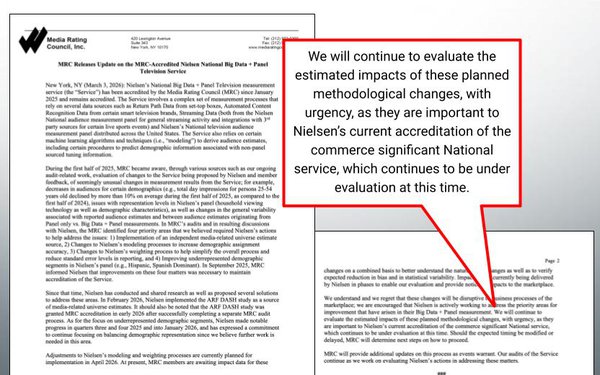
MRC Blows Whistle On Nielsen Big Data + Snafu

Industry ratings watchdog the Media Rating Council (MR) this week disclosed major problems in Nielsen's Big Data + panel measurement service that have caused "seemingly unusual changes" in its audience estimates, including a double-digit decline in adults 25-54 viewing, as well as other issues.

In a statement published on its website Tuesday the MRC said it became aware of the issues during the first half of 2025 from undisclosed sources, as well as part of its ongoing auditing of Nielsen's service and described the unusual changes as:

  • Decreases in audiences for certain demographics, including an average 10% decline in total day impressions for persons 25-54 vs. the same period a year earlier.
  • Issues with representation levels in Nielsen’s panel, including household viewing technology, as well as demographic characteristics.
  • Changes in the general variability associated with reported audience estimates and between audience estimates originating from panel-only vs. Big Data + panel measurements.

advertisement

advertisement

In its statement, the MRC did not explain why it is disclosing the problems now, but it said that it informed Nielsen in September 2025 that it needed to do four things in order to maintain MRC accreditation for the service:

  • Implementation of an independent media-related universe estimate source.
  • Changes to Nielsen’s modeling processes to increase demographic assignment accuracy.
  • Changes to Nielsen’s weighting process to help simplify the overall process and reduce standard error levels in reporting.
  • Improving underrepresented demographic segments in Nielsen’s panel (e.g., Hispanic, Spanish-dominant). 

Regarding the first area, the MRC noted that Nielsen began implementing the Advertising Research Foundation's DASH (Universe Study of Device & Account Sharing) service, which the MRC previously accredited and which is increasingly becoming an industry default standard for media universe estimates.

Regarding under-represented demographic segments, the MRC characterized Nielsen as making "notable progress in quarters three and four 2025 and into January 2026," and disclosed that Nielsen will make "adjustments" to its modeling and weighting processes beginning in April.

The timing of those changes could be disruptive for the advertising marketplace heading into 2026-27 upfront negotiations, in which Nielsen still remains the default currency, though a number of alternative currencies are also being implemented by buyers and sellers.

"We understand and we regret that these changes will be disruptive to business processes of the marketplace; we are encouraged that Nielsen is actively working to address the priority areas for improvement that have arisen in their Big Data + Panel measurement.," the MRC stated, adding that the Nielsen service remains accredited for now, but is "under evaluation at this time."

4 comments about "MRC Blows Whistle On Nielsen Big Data + Snafu".
Check to receive email when comments are posted.
  1. Ed Papazian from Media Dynamics Inc, March 5, 2026 at 4:05 p.m.

    The main question concerns whether the "problem" is with the big data panels which supply the set usage estimates or with the much smaller people meter panel which supplies the crucial viewer-per-set factors which are used to project the viewer "demographic" estimates. From what I gleen from the MRC statement, Nielsen may have a cooperation issue with some-or many--of its 27,000 people meter homes. Their resident composition re age may have changed due to panel turnover or other factors or it's possible that some members--those in the middle age groups or certain ethnicities ---some newly recruited--are being less cooperative in pressing their buttons to indicate that they are viewing when a channel or show is selected.

    While I assume that answers to these and other questions will be forthcoming, the main issue from a time buying and selling viewpoint is whether the "audience" is being correctly assigned  on a seller by seller basis. If their shares are more or less OK, artificially caused shortfalls in audience delivery can be handled by stastical adjustments between the buyers and sellers.

  2. Jack Wakshlag from Media Strategy, Research & Analytics replied, March 5, 2026 at 5:02 p.m.

    My reading here is that MRC is revealing an issue from Sept. 25 that yielded lower viewing estimates but has since largely been addressed to its satisfaction. I'm guessing this should be good news for viewing levels going forward. 

  3. Thomas Ziangas from Hallmark Media, March 9, 2026 at 9:17 a.m.

    Revealing the issues is different from identifying the issues, the problem is and still is that Nielsen Big Data + Panel was, is and continues to be a service that is "under construction". Issues or as I would say methodological processes have been identified by clients for over 2 years and Nielsen has taken too long to move forward. This will be another Upfront that there is too little data and time to make the most accurate estimates that allow buyer and seller to transact confidently. What is most bothersome is that Nielsen has been under reporting viewing with the introduction of Big Data in 2025.

  4. Ed Papazian from Media Dynamics Inc, March 9, 2026 at 9:44 a.m.

    Thom, how do we know that Nielsen has been "under reporting"  viewing? Isn't it possible that the old system was "over reporting" viewing? How does one determine what's the exact truth--down to the last few hundred "viewers" ---for every show on national TV? 

    The  main problem-----if there is a problem----is whether the new system is finding a greater share of viewing for one seller than another that can be proven bo be significantly incorrect. So far I have seen no claims about anything like that. So, no matter what the correct numbers of adults 18-49 are--for programs that haven't even been produced yet--- how is the coming upfront jeopardized? Each seller will still be credited with a certain share of audience. If the buyer and sellers agree that  the resulting 18-49 ratingis  are "under stated" by 1-2%, then simply up the figures slightly to account for that.  

Next story loading loading..