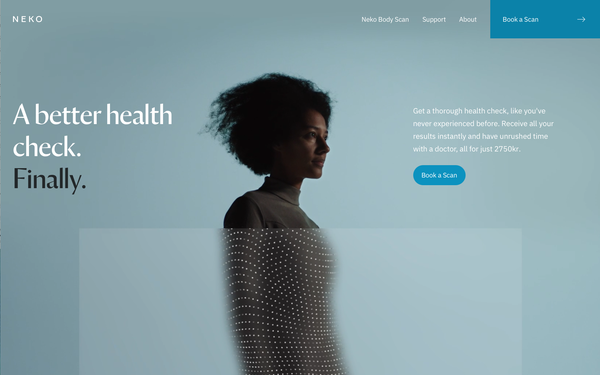
Daniel Ek, Spotify co-founder, is also
co-founder of Neko Health, a startup that does full-body scans, with plans to open its first U.S. location in New York sometime soon.
The scans, provided by Neko Health, can potentially detect
possible major potential health problems. But the medical community is divided on the benefits, and some warn that false positives can prompt unnecessary doctor visits.
I know. I had my first
full-body scan 14 years ago in Southern California at one of its rivals. It detected localized scarring in a portion of my lungs, likely from smoking cigarettes for a few years as a teen.
The
scans are layered. For example, these types of full-body scans typically provide separate images of the vascular system, organs and other elements of the body -- or at least they used to -- in order
to check for risk of cancer, diabetes, possible high blood pressure, and other diseases.
advertisement
advertisement
Predictive data modeling and contextual targeting tie together full-body scan companies
like Neko Health and platforms like Spotify. They do not typically share raw medical records, but they could use the same data-driven models to predict health needs and influence
behavior, although this is not an admission that they do.
Similar to Spotify's subscription model, Neko Health focuses on long-term data tracking, where the service increasingly becomes
valuable as it collects more data points throughout years of scans. LiveRamp’s website has a post on tying
in healthcare data.
Neko Health's CEO Hjalmar Nilsonne told Bloomberg the company plans to expand its diagnostics and data capabilities, although it is not yet
profitable.
Data could potentially become the key for ad targeting for the medical community -- better drugs and services — despite highly restrictive HIPPA regulations in the U.S.
I did a search on Google AI Mode: “How do full-body scan companies legally share information about patients for use in ad targeting in the U.S.?”
“Through explicit patient
authorization the use of de-identified data or by operating as non-HIPAA covered entities that fall under less stringent consumer privacy laws,” AI responded to the question of
how way full-body scan companies and researchers in the U.S. can legally share patient information for ad targeting.
Not many people actually read the fine print in a consent form, although
companies often include an optional consent form during digital check-in that asks whether they agree to share data for "personalized health content" or ads.
Under the HIPAA Privacy Rule, covered healthcare providers are generally prohibited from sharing this
information for marketing purposes without a patient's written authorization. Authorizations typically come with a date stamp, valid for one year, and can be revoked by the patient at any
time.
Neko Health, founded in 2018, operates in Sweden and the U.K., but its working through regulatory approval in the U.S.
There are several advanced imaging companies already
in the U.S. Prenuvo, a company that offers full-body MRI screening services designed for the early detection of health conditions, aim to provide a complete look at organ systems without
radiation or contrast, typically in less than an hour.
In one of its articles, Prenuvo pointed to a Polaris study of
1,011 individuals who went through a whole body MRI. Cancers were found in 2.2% of participants, and 68% of these cancers were in organs without established screening protocols.
Neko’s latest analysis of data from its scans in Sweden found that 1.2% of patients were flagged with potentially life-threatening conditions, including leukemia, severe diabetes and
cardiovascular disease, that may otherwise have gone undetected, as reported by Bloomberg.