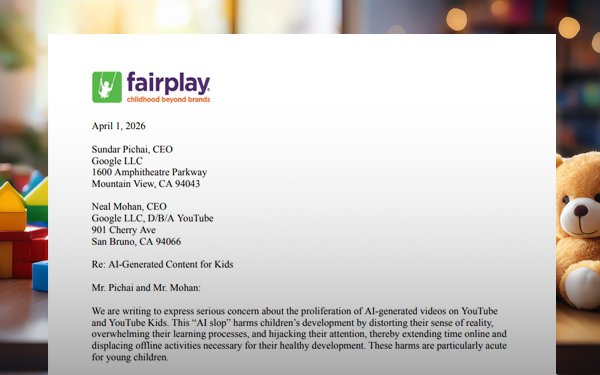
Demands made by child development experts to prohibit Google
from serving AI-generated videos to children on YouTube and YouTube Kids could significantly impact how advertisers reach young audiences the video platforms.
Child development experts have
demanded that Google prohibit AI-generated videos from being shown to young viewers on its video platforms YouTube and YouTube Kids, and halt investments in using AI-generated videos for children.
“This content, riddled with errors and disturbing images, isn’t just benign entertainment; it's toddler misinformation,” says Dana Suskind, professor of surgery and pediatrics,
and co-director of TMW Center for Early Learning. “It’s arriving during a critical developmental period, when children’s brains are being wired, truly, for a lifetime.”
The group criticizes that the low quality of AI-generated content, referred to as AI "slop," distorts a child’s ability to identify reality from fiction, as well as influence their
attention span and disrupts their adjustments to social situations.
advertisement
advertisement
A letter sent to Google
CEO Sundar Pichai and YouTube CEO Neal Mohan -- signed by more than 200 specialists on children, advocacy groups and schools -- surfaced Tuesday. It addresses these issues and raises
concerns about the lack of substance in many AI-generated YouTube videos that claim to be educational.
"Despite promises to keep kids safe, the proliferation of AI slop content
demonstrates once again that YouTube prioritizes profit over the well-being of its most vulnerable users,” the letter reads. “In fact, multiple content creators brag about earning millions
off of plotless, mesmerizing AI content for young children, and the top-watched AI slop channels targeting kids have earned over $4.25 million in revenue annually so far.”
Led by child
safety nonprofit Fairplay, the letter was signed by the American Federation of Teachers, the National Black Child Development Association, and Mothers Against Media Addiction (MAMA), as well as
experts like Jonathan Haidt, author of The Anxious Generation.
The group, which announced a public petition, argues that time spent looking at a screen replaces real-world activities
key to child development, socially and emotionally.
"We have high
standards for the content in YouTube Kids, including limiting AI-generated content in the app to a small set of high-quality channels," a Google's YouTube spokesperson told
MediaPost. "We also provide parents the option to block channels. Across YouTube, we prioritize transparency when it comes to AI content, labeling content from our own AI tools, and requiring creators
to disclose realistic AI content. We’re always evolving our approach to stay current as the ecosystem evolves."
Regardless, the group demanded a toggle switch in parental
controls, so parents have the option to turn off AI-generated content even if a child searches for it, with clearly labeled AI-generated content on YouTube; bars the content from appearing on YouTube
Kids; prohibits child-focused videos for “Made for Kids” on YouTube, and prohibits algorithmic recommendations of AI-generated content to users under age 18.
Advertisers would have
a primary benefit in less mass-produced content that lacks substance, which could potentially lead to better engagement from human-curated content.
YouTube Kids does run a limited
number of ads on the site. When a child selects a video in the app, the child may see an ad introduction followed by a video ad — marked with “Ad” or "Sponsored" — before the
video you selected.
These are paid advertisements that Google describes as "approved as family-friendly." All Paid Ads undergo a review process for compliance.