Consumers may complain about streaming content pricing, but
they enjoy the ease of one-stop shopping.
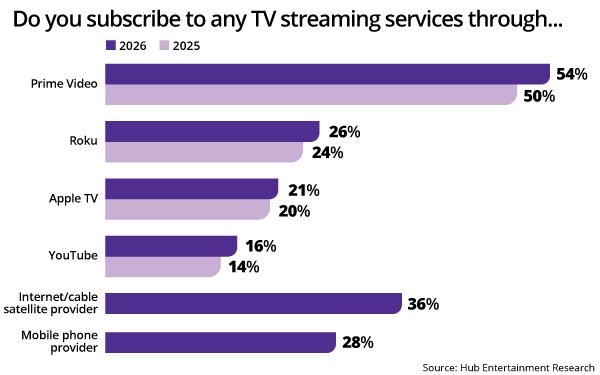
Hub Entertainment Research notes that some of the strongest aggregators here are led by Amazon Prime Video. Fifty-four percent of respondents say they
use Amazon Prime Video to get one or many streaming services, up from 50% in 2025.
At the same time, 36% of respondents also say they buy streaming services through more traditional virtual,
cable, or satellite RV providers.
Another 28% of respondents say they go through a mobile phone provider such as T-Mobile, Verizon, or AT&T to buy streaming services.
Behind this
group are Roku at 26% (up from 24%), Apple TV at 21% (versus 20% previously) and YouTube at 16% (versus 14%).
"TVs are the biggest screen and are best positioned to be 'the brain' to help
coordinate things across the home," says Jason Platt Zolov, Hub senior consultant.
advertisement
advertisement
"Leading TV operating systems have an opportunity to develop enhanced AI partnerships across devices that
will only make consumers happier," he adds.
Looking at just those specific operating systems for a smart TV or streaming media player or device, Roku still commands a strong position, with a
55% market share.
Samsung's Tizen OS is next at 45%, followed by Amazon Fire TV OS at 35%.
After Samsung, among the top smart TV manufacturer’s operating systems are LG webOS
(28%), Vizio’s SmartCast OS (16%) and Xumo TV OS (9%).
The survey was conducted with 2,659 U.S. consumers ages 16-74 who were interviewed in February 2026.