Marketers try to determine how to
reach Gen Z on screens, but Lyft executives believe reaching them on the go is a better way.
The ride-hailing company released data on Wednesday from a study based on ads and the best way to
reach this generation as they travel through the real world.
The analysis is based on first-party data from 94 million rides. This was then further analyzed to give marketers insights into
what it all means.
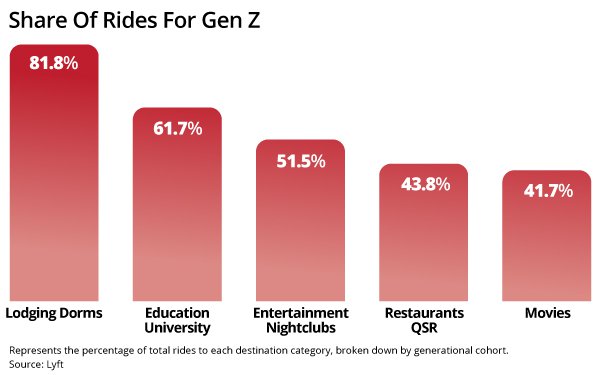
The Gen Z Insights Report analyzed experiences and real-life moments of this generation that represents 24% of riders, but accounts for 28% of rides. They often head to
restaurants, nights out, and events.
Many Gen Z riders began using Lyft or ride-hailing services in high school or college, often through shared or family accounts, and
continued throughout adulthood.
advertisement
advertisement
As a generation, they are less likely to have a driver’s license than teens in recent decades, and their movement skews heavily toward nightlife and
weekends.
These riders are not commuting or running errands. They compare ride options, check wait times, and watch the map in the app.
Some 23.5% of Gen Z rides occur between 12
a.m. and 5 a.m., and 31.2% of the rides occur on the weekend. For millennials the percentage is 28.9%, and for boomers it is 23.8%.
The data found that 46.5% of all rides to Taco Bell are
with Gen Z -- and 49.8% of all rides to Dunkin’ Donuts.
These are high-attention moments when riders are unhurried, more engaged, and open to making spontaneous decisions about where to
go next.
They do not click impulsively, but they do pay attention when content feels relevant or entertaining.
The high video completion rate — between 78% and 90% — and
notification interaction shows that the right message, in the right moment, gets viewed.
They tend to engage more on every platform, including 14% on push notifications, 11$ on local
notifications, 8% on infotainment, and 21% on ride offer notifications.
Female Gen Z riders are especially responsive to promotions, coupons, and value-driven messaging, according to the
findings.
Large student populations are markets where they are most on the move, along with dense social ecosystems, and active nightlife, with a focus on areas like Los Angeles, Boston and
Chicago.
These riders look for ride-saving options, balancing affordability, speed, and convenience, making decisions on price and actively comparing and evaluating choices. Some 67% of riders
tap to check pricing after a ride, compared with 16% of millennials.
Sherwood News, the media arm launched by the retail trading platform Robinhood, reported on Wednesday
that Lyft’s Flexdrive unit is constructing an 80,000-square-foot facility about the size of 1.5 football fields.
The facility is scheduled to open this fall and will
service, charge, and maintain Google Waymo’s autonomous vehicles. The location built for EVs is designed to keep hundreds of cars on the road as much as possible, handling the unglamorous but
critical work of cleaning, charging, storage, and repairs. As the fleet scales,
Lyft will reportedly add satellite charging and cleaning sites around the city to help speed up turnaround times
and keep wait times low.
However, no information has been provided on whether or when advertising supported by Lyft or Google will come to those vehicles.