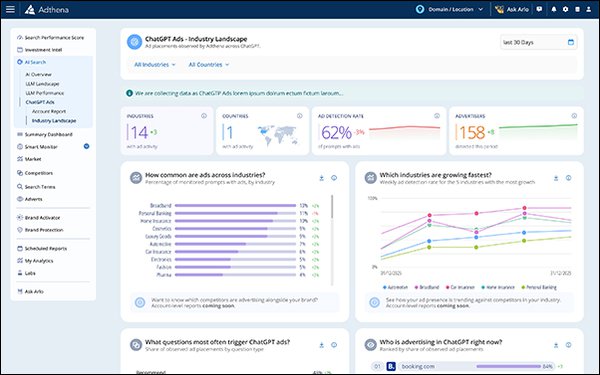
Adthena this week launched the free migration
tool, "AdBridge," that converts Google Ads campaigns into formats accepted by the ChatGPT Ads platform.
AdBridge analyzes advertisers’ search campaigns to generate keyword lists,
negative keywords, and competitive insights that can be directly applied to ChatGPT campaigns. It tells brands how and when they serve up for specific auctions, how often they appear, and prompts that
trigger those placements—at least for now.
The tool is designed to save advertisers time by enabling them to repurpose campaigns for different platforms -- a practice already used by
Microsoft and Google.
Marketers might already know the ad converts well on Google Ads, but the same ad does not always work seamlessly on other platforms.
Specific technical details or
strategic goals are some reasons that porting or migrating campaigns may not always work. It depends on what makes the campaign most useful on a specific platform, according to one ad executive.
advertisement
advertisement
Microsoft or Google, for example, may allow for certain characters that ChatGPT Ads does not. The two companies have used this strategy for years to gain new ad business from other platforms,
and each others.
Adthena, a paid search intelligence platform, has a full ChatGPT Ads solution in the works, as well as the migration wizard launched this week, expected to launch May
11.
Several of Adthena's Fortune 500 clients are currently participating in OpenAI's ongoing ChatGPT Ads trial. The company provides the intelligence layer that helps advertisers track, analyze,
and optimize their performance.
Ashley Fletcher, Adthena CMO, has been active on social media, writing about ChatGPT Ads and what Adthena’s ad marketers see across the
platform.
Fletcher pulled 580 ads from the platform this week to see what ChatGPT ads look like. The analysis shared on LinkedIn suggests people use ChatGPT as an educational tool, not a
buying tool.
Sixty-one percent of ads triggered on prompts beginning with the word "best" during the test, Fletcher wrote on LinkedIn.
Another 31% triggered ads based on "X vs Y"
comparisons of things, and only 9.5% triggered ads based on genuine "how-to" questions.
“The intent profile looks almost identical to Google Shopping — bottom-funnel,
comparison-led, transactional,” he wrote. “Not the new top-of-funnel discovery channel some have been describing.”
He also discovered that it is normal to see brand hijacking
on comparison prompts, when users typed "X vs Y," the ad shown was not one of the named brands in 86% of cases. For example, if comparing "Drizly vs DoorDash" an ad from Dollar General would surface,
or if comparing "Chanel vs Dior perfume" an ad from Nordstrom would serve up.
Another interesting point raised by Fletcher is that finance ads still run despite OpenAI's restrictions. The
company's policy limits financial services to approved advertisers and bans crypto outright. Finance and insurance comprised 9.5% of the dataset, while Liberty Mutual placed 12 times, and Insurify
placed 10 times, respectively, demonstrating the likelihood that bugs need to be addressed.