Hosting
Tuesday’s and Thursday’s opening games of the NBA Eastern finals, New York’s Madison Square Garden (MSG) is prime advertising real estate right now,
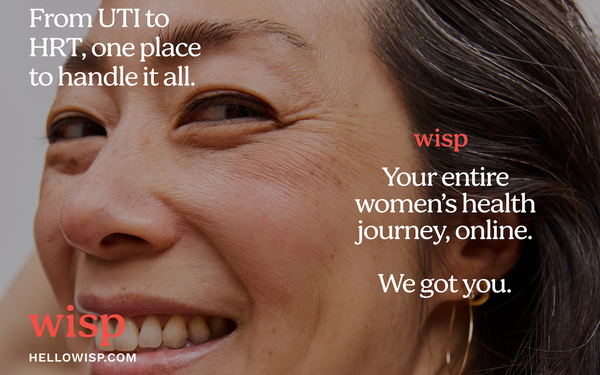
and women’s sexual telehealth provider Wisp has secured a key location right outside the arena on the corner of Seventh Avenue and West 33 Street.
The billboard, which Wisp Senior Vice President of Marketing Tim Ragland tells Marketing Daily “highlights how women can feel empowered to use Wisp’s platform for
acute and ongoing care from UTI to HRT,” is part of a larger Big Apple “We Got You” campaign “leaning fully into the way women actually talk about their health in real
life.”
“Historically, much of women’s healthcare marketing has felt sterile and lacking real connection, and we wanted to move away from that,” says Ragland.
advertisement
advertisement
The campaign’s copy “came directly from listening to how women actually talk about their health, which is rarely how healthcare brands talk about it,” adds Katie Klencheski,
founder-CEO of creative agency Smakk Studios. “Women are funny, frustrated, frank. They Google things at midnight. They've been dismissed by doctors, confused by their own bodies, and told their
symptoms are probably nothing. We wanted the campaign to reflect that reality, not sanitize it."
Wild postings in several areas of Manhattan and Brooklyn use such lines as “From
heavy bleeding nobody explained to care that takes it seriously,” “From birth control confusion to a plan that fits your life,” and “From a six-month waitlist to a same-day
prescription.”
These posters, Ragland explains, “discuss the inner dialogue and the real practice that women hold the weight of playing detective and care coordinator of their
health while experiencing dismissal, stigma or shame in areas. The messaging is intentionally conversational and emotionally recognizable, reflecting the campaign’s broader goal of mirroring the
language women already use online and with each other. Women carry hundreds of questions, doubts, and experiences about their bodies—most of which go unanswered,
dismissed, or minimized.”
“The ads aren't trying to explain Wisp,” Klencheski elaborates. “They’re trying to make women feel recognized. And that
meant being thoughtful about who we were talking to. We built the creative to stretch across life stages, pulling from the specific frustrations, moments, and language that resonate at each one
rather than defaulting to a single ‘everywoman’ voice that ends up speaking to no one.”
Despite its name, “Wisp isn't a whisper brand,” she
states. “We also wanted the boldness of the brand to come through in the copy….This audience can tell when a brand is actually in their corner versus just performing it.”
While based in San Francisco, the eight-year-old Wisp has often focused its ad efforts out-of-home in New York City, and this marks its biggest effort yet.
“NYC
is where culture, media, internet conversation, and real-world visibility intersect,” explains Ragland. “It’s where we first made headlines by bringing the word ‘vagina” to Times Square. Since then, we’ve continued to
launch thought-provoking campaigns in the city that challenge the way
women’s health is typically talked about in public spaces.”
Wisp, though, is also reaching a national audience through a paid digital component, which includes
publishers like The New York Times and what Ragland terms “environments where women are already discussing symptoms and seeking answers.”
The overall campaign can be
expected to “expand into addition markets over time,” Ragland acknowledges, noting“how universal these experiences are for women, regardless of
geography.”
The aim, says Klencheski, “is to shift how women see Wisp—from a brand they might turn to once, for one specific
health concern, to a brand they keep coming back to across their entire health journey. Ultimately, we want women to walk away feeling like Wisp gets them. Not in a vague, marketing-speak way, but in
a way that's specific and honest enough to actually earn that trust.”
The billboard outside MSG began running on May 12 and will be live through May 24.