It’s time for consumers to stop
feeling just “fine,” according to two new campaigns, one from pharma giant Johnson & Johnson, the other from women’s body care brand Megababe.
J&J’s
“Generation Fine”
Tied to Mental Health Awareness Month, the 140-year-old Johnson & Johnson has launched “Generation Fine,” which it says is designed to empower
patients “with major depressive disorderto take the first step in moving beyond ‘good enough’ by talking with their healthcare provider.”
J&J says the
campaign is “informed” by a Wakefield Research August 2025 survey of 850 adults currently taking an oral antidepressant to treat major depressive disorder, which found that nearly 80% of
them believe their treatment wouldn’t help them reach remission. In addition, roughly two-thirds of them continue to experience ongoing symptoms that impact daily life, and 40%
haven’t raised concerns with their provider, “often citing lack of time or energy.”
advertisement
advertisement
“Generation Fine” centers on a dedicated educational website, with traffic to it being driven “across social, media and advocacy channels,” a J&J spokesperson tells Marketing Daily.
A key aspect of the site and the outreach for it consists of patient stories including those of former Chicago Bears NFL player and current CBS analyst Kyle Long and mental health expert Dr.
Jessi Gold, who are serving as campaign ambassadors.
The Mental Health America nonprofit is also providing its expertise.
The campaign will continue beyond May.
Beyond the
“Generation Fine” non-branded awareness campaign, J&J’s mental health drug Caplyta, obtained through an acquisition in early 2025, was approved by the FDA to treat MMD in
November. J&J also markets Spravato for the condition.
Megababe’s ‘Not So Fine’
Tied to Women’s Health Month, the nine-year-old Megababe has launched
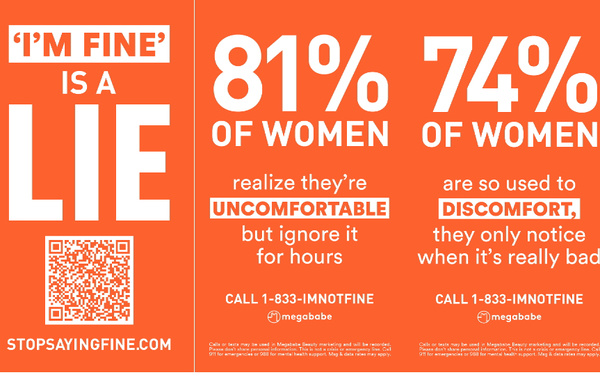
“Stop Saying Fine,” which it says “puts a name to the hidden cost women pay when they minimize their own discomfort to keep moving through the day.”
Megababe says the
campaign is “anchored” by a new “I’m Fine Index,” based on a SurveyMonkey survey of 503 adult women, which found that 96% of them say “I’m fine” when
they’re not at least weekly: 81% “realized they were uncomfortable and ignored it for hours”; 77% default to a standard that “if it’s not horrible, it’s
fine”; 65% have “never told their doctor about a recurring body discomfort”; and 58% agree that” being a woman means dealing with discomfort.”
“Stop
Saying Fine” has a campaign website and has set up a 1-800-NOTFINE hotline, which the fine print notes is “for promotional purposes only and is
not a crisis, emergency or mental health hotline.”
Those resources are being supported with an out-of-home campaign, using New York City bus shelters, plus over 1,000 wild postings in
the city.
The brand has also teamed up with Social Goods on a “Stop Saying Fine” line of caps and T-shirts, with 10% of proceeds going to mental health nonprofit SeekHer.
Beyond the “Stop Saying Fine” non-branded awareness campaign, Magababe sells a line of CPG products for such not-so-fine yet stigma-prone conditions as chafing, ingrown nails,
hemorrhoids, B.O. and “boob sweat.”