Marketers just can’t seem to escape the
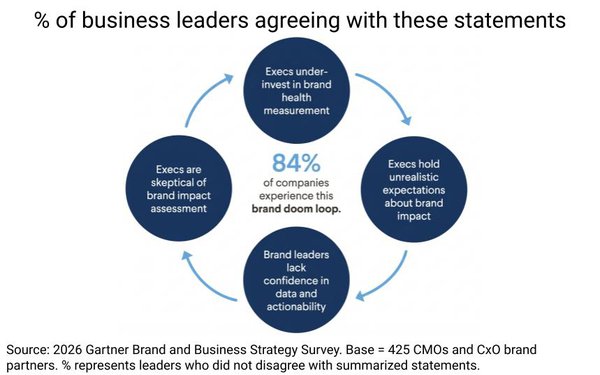
tyranny of performance marketing metrics. Gartner has just released a survey of more than 400 senior marketing execs and finds that 84% say the companies they work for are trapped in that familiar
cycle known as the “brand doom loop.”
It’s because companies underinvest in brand measurement and lack confidence in the results. Unsurprisingly, it then becomes harder for
them to make the case for sustained brand marketing budgets, let alone increases, to increasingly skeptical CEOs and CFOs.
That’s contributed to brand marketing being viewed as an
expense that drains capital, rather than an investment that increases revenue.
The “doom loop” phenomenon, first quantified by WARC last year, found companies cutting brand
investment to fund performance marketing, which typically produces initial gains in efficiency. This spending strategy is typically optimized using faulty measurement. Over time, performance marketing
costs more, because the brand has become less memorable. That forces more spending into performance marketing, even to maintain flat results.
advertisement
advertisement
In that research, WARC found over-investing in
performance marketing zapped full revenue ROI by 40%. WARC said earmarking at least 30% to brand marketing efforts, but usually between 40% and 60% -- and carefully balancing brand and performance
marketing -- led to an average uplift of 90% in ROI.
Gartner’s research finds a similar benefit, noting that companies with a strong brand strategy are twice as likely to exceed growth
goals.
Currently, the struggle stems from CMOs who are unable to make a strong brand-spending case. “Brand has long been treated as a communications asset, but it is actually a growth
engine,” said Julie Reeves, vice president and analyst in Gartner’s marketing practice, in the announcement. “The challenge is that most organizations lack the measurement discipline
and executive narrative needed to connect brand health to business performance.”
Gartner also asked others in the C-suite what might help, with 50% of those execs saying that they're
open to elevating brand’s strategic role. More than 50% want their CMO to clarify the relationship between brand and business strategy, and 43% want a clear, simple story that explains how brand
health impacts business performance.