High
gasoline prices are cutting into America’s household budgets, a trend that's showing up in the snack aisle, PepsiCo's CEO says. And while the company's big investments in World Cup
marketing helped drive gains internationally — especially in Europe — it's too soon to say whether that momentum will extend to American shoppers.
Sales rose 6.4% to $24.18 billion, better than expected, with organic sales rising 2.4%. But growth stemmed primarily from global markets. In North America, beverages
eked out a 1% gain, while sales in North American foods slipped 2%.
That news disappointed investors, who had been hoping to see Pepsi build on the momentum
it showed last quarter — much of it driven by the company's decision to lower prices to win back customers. The North American food division accounts for about 30% of the company's operating
profits, and on the earnings call, CEO Ramon Laguarta was clear that the solution — though currently elusive — lies in creating new products that cater to changing trends, and in finding
new occasions to make Pepsi's foods matter. That includes expanding in the convenience channel and capitalizing on growing consumption of food away from home.cur
advertisement
advertisement
Laguarta said that strategy should be "a way for our North America business to continue to be a compounder for us at a good pace. And it's not."
While he believes the U.S. foods division could currently grow at 3%, it's currently at 1%. "The consumer is worse than what we had anticipated, and it's driven
mainly by gas prices," he said. Even though gas prices have moderated over the past year, consumers are still wrestling with household spending more broadly.
Pepsi still dominates the snack food universe: it now holds five of the 10 largest "permissible snack" brands, including better-for-you lines like Doritos' Simply NKD
and SunChips.
It's too soon to say whether Pepsi's splashy — and pricey — FIFA World Cup-linked campaigns will pay off in the U.S. These results
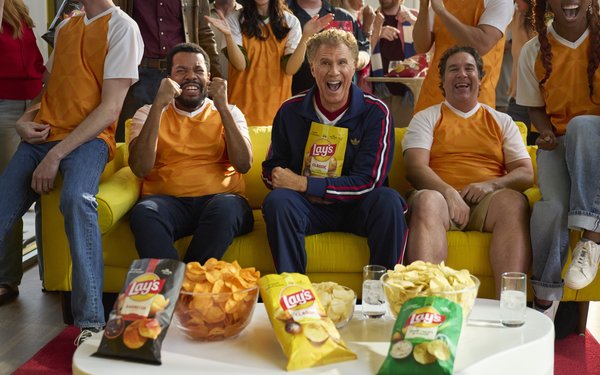
cover the second quarter, which ended just days after the tournament kicked off last month, so any sales impact would only just be starting to show up. For Lay's, that meant loading celebrities Will
Ferrell, Marshawn Lynch and David Beckham into its campaign, while Pepsi also paid to make Quaker the tournament's official breakfast.
Internationally, the
payoff looks clearer: The company said food-related World Cup sponsorships are already boosting results in Europe and Latin America.
There are early signs of
traction in the U.S., too, at least in terms of consumer attention. A recent YouGov Brand Index report found Pepsi's World Cup ad efforts rank #2 among beverage brands, ahead of official FIFA
soft-drink sponsor Coca-Cola (#5), on the strength of a campaign featuring global soccer stars. (Café Bustelo, owned by J.M. Smucker, ranks #1 overall, driven by its "Game Face" campaign.)
Pepsi's snack brands also placed well, with Doritos (#7), Cheetos (#11) and Ruffles (#14) all ranking among the top movers with World Cup fans.
While those
perceptions may convert into North American sales gains, some are frustrated by the loss of momentum. Deutsche Bank analyst Steve Powers, for example, writes that the results indicate Pepsi's recovery
efforts are still "half-baked."
Morningstar analyst Kristoffer Inton is more encouraged, however, noting that PepsiCo's new product push and recent price cuts
are bearing fruit amid category-wide struggles, even if management now expects a more gradual recovery. "We think the market underappreciates PepsiCo's unwavering focus on innovation and
affordability," he writes. He expects sales to grow in the mid-single digits over the next several years, "as the North American consumer situation stabilizes."