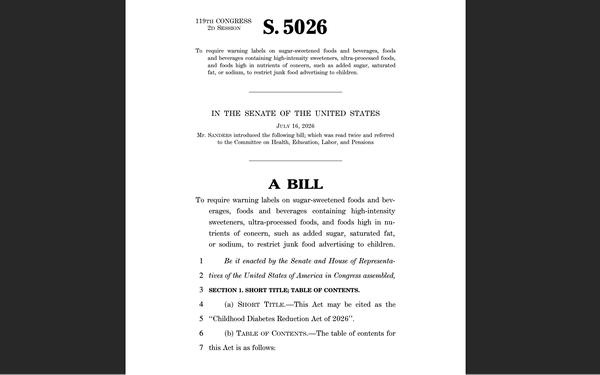
A bill that would ban
junk food advertising to children under 13 raises "significant" First Amendment concerns, ad industry groups said in a letter sent to lawmakers Tuesday.
The Childhood Diabetes Reduction Act of 2026, introduced by Senator Bernie Sanders (I-Vermont), includes provisions
that would prohibit companies from marketing or advertising junk food "in a manner that reasonably appears to be directed at children.”
The measure "would regulate
truthful, non-misleading advertising concerning products that may lawfully be sold in commerce," the Association of National Advertisers, American Association of Advertising Agencies and American
Advertising Federation say in a letter sent to Sanders and Senator Bill Cassidy (R-Louisiana).
advertisement
advertisement
The groups add that the bill "may have the practical effect of discouraging
lawful advertising for ordinary food and beverage products, including, for example, restaurant advertising and advertising for products lawfully sold in commerce, even where the intended audience is
not primarily children."
The bill provides that ads will be considered child-directed if they use "themes or promotional strategies that appeal to children" -- such as "fun or
fantasy" themes, cartoon characters, social media influencers, free toys, interactive games or apps.
The ad groups write that those factors "are inherently subjective, making
it difficult for regulated entities to determine in advance what advertising conduct is prohibited."
The organizations add that many of those factors "are commonly used in
mainstream advertising regardless of the intended audience."
The bill also provides that ads are child-directed if placed in media where children make up at least 30% of the
audience.
The ad groups say that threshold is low enough to "encompass a substantial portion of mainstream media."
"While well-intentioned, this bill
misses the mark by imposing broad restrictions on protected commercial speech that may extend well beyond advertising directed at children, while relying on vague standards that create substantial
uncertainty regarding the scope of the prohibition," the organizations write.
The bill would also require warning labels on junk food.
Some advocacy groups, including
the nonprofit National Center for Health Research, support the bill. That organization
said this week that the measure "would greatly improve children’s health by banning ads for junk food that are aimed at children."