The Interactive Advertising Bureau’s (IAB)
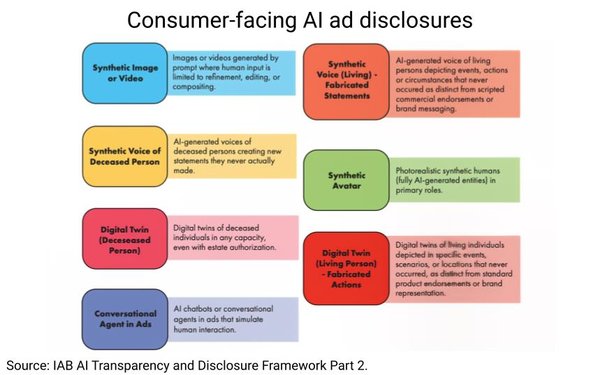
open approach to labeling received an update this week. The organization released the second version of its AI Transparency and Disclosure Framework.
"Trust is everything between a brand and
its customers, and being honest about AI is part of earning it,” notes IAB Vice President-AI Caroline Giegerich,.
The framework points to a New York University study, which found that informing consumers an ad was made with
generative AI cut its click-through rate by 31.5%.
"That cost is warranted where AI use could mislead consumers," the study notes. "However, labeling applied to AI involvement that poses no
risk of deception penalizes advertisers without protecting consumers. This is why disclosure should be reserved for cases of material risk, not applied across the board."
advertisement
advertisement
It establishes an
industry baseline for when and how AI use in ads should be disclosed, and aims to find a balance between objectives focused on transparency vs. business objectives.
The update also alerts
advertisers that overusing AI disclosures can lead to “label fatigue” for consumers seeing the ads and content, making them less effective in the long term.
The framework
recommends three thresholds advertisers should address to determine how content will impact consumers and whether they should use a label. They include:
- The potential of deception
- That expectations are made clear
The IAB published the initial framework in January, but the update comes as marketers and
regulators struggle with how to regulate and/or self-regulate the technology. Since initial publication, laws and regulations surrounding AI disclosure have been implemented across California, New
York, Asia, and the European Union.
Sonata Insights, a research company founded by Debra Aho Williamson, provided some of the data behind the decision to build the framework.
Her
research found that while some consumers viewed AI use in creative contexts positively, others saw it as synthetic and inauthentic.
The IAB also notes that more than half of consumers
said brands should disclose when an ad is fully AI-generated or uses AI imagery or video
Interestingly, 73% of Gen Z and Millennials said clear disclosure would increase or not affect their
likelihood of purchasing a product.
The update also called out differences between advertisers in the U.S. and those in the European Union (EU).
Advertisers in the U.S. can choose
between a standardized sparkle icon or a clear text label when identifying AI generated content, whereas those in the EU face more stringent rules.
Those in the EU must follow rules from
Article 50, which went into place Aug. 2, 2026, requiring AI-generated content and deepfakes to be disclosed, but does not require a specific icon.
The framework is designed to represent an ad
industry perspective -- not to replace state and international regulation -- which the IAB notes takes precedence over industry self-regulation.
“As jurisdictions adopt different
disclosure thresholds and formats, the framework gives advertisers, agencies, publishers, platforms and technology partners a shared industry baseline for compliance, rather than requiring a
jurisdiction-by-jurisdiction approach,” the IAB wrote in the release.