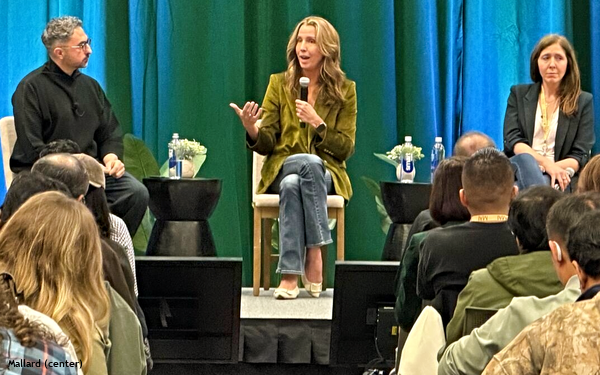
Andréa Mallard has spent the past seven
years leading marketing at Pinterest. Now she has joined Microsoft AI as its new chief marketing officer.
“AI is already the most consequential technological shift of my
lifetime,” Mallard wrote on LinkedIn, adding that this is which is why she stepped into the role two
weeks ago. “It will shape our children’s lives in ways that are difficult to predict.”
Prior to joining Pinterest in 2018, Mallard held the role of CMO at Gap brand Athleta,
as well as Omada Health. Now she reports to Microsoft AI CEO Mustafa Suleyman.
"As Mustafa put it at last week’s global MAI team meetup, 'AI must work in service of people. Not
the other way around. Ever.'" she wrote.
Earlier this month, Mustafa shared details of a test for the next phase of AI technology.
"The next big milestone I'm watching for on our way to AGI: Artificial Capable Intelligence (ACI)," he wrote on X. "Can an agent take $100k and legally turn it into $1M? To me that's the modern Turing Test."
While the test is simple in context, it is difficult to execute. He described it as a
“modern turning" point that will show how AI systems can plan, reason, make decisions, and operate within real-word rules.
advertisement
advertisement
Mustafa two months ago posted about "Humanistic
Superintelligence (HSI)" on LinkedIn. He described it as "advanced AI capabilities that always work for, in service of, people and humanity more generally."
HSI is a concept
championed by Microsoft AI and its Superintelligence Team in 2025 and early 2026, and represents a philosophy where AI is viewed as a specialized tool rather than a replacement for humans.
Microsoft uses the concept of HSI to support advertising, along with new features and services for its advertising business.
The latest updates announced last week focus on more controls,
transparency, and making products easier to use.
Customer-acquisition features for Performance Max campaigns and expanded automation for responsive search ads mark the latest AI-driven
campaign optimization across its advertising network. This will automate asset creation. For some early testers, the feature has delivered 5% click-through rate improvements.
Functions enable specific targeting of new customers with options to either increase bids or focus on customer-acquisition campaigns, bringing new customer revenue alongside existing Performance
Max campaign objectives.
Two other updates center on making Performance Max campaign imports efficient through increased search theme limits.
Advertisers can now use up to 50 search
themes, doubling the previous limit.
When asset groups contain images that do not meet size requirements, exceed the previous 25-image limit, or include auto-generated logos, the rest of the
asset group will still be imported.
Microsoft also introduced share of voice metrics, which aggregate impression data from search and shopping, for Performance Max campaigns. It provides
historical data that extends back to November 10.
The metrics include impression share, click share, impression share lost to budget, and impression share lost to rank, addressing advertiser
demands for increased visibility into automated campaign performance.