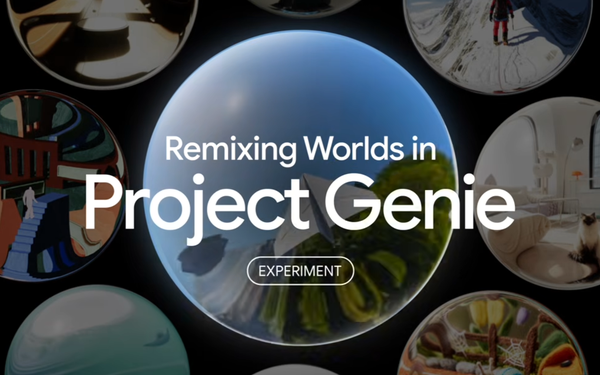
Google DeepMind began granting users access to "Project Genie" on
Thursday for Google AI Ultra subscribers in the U.S. age 18 and older. This experimental research prototype allows users to create, explore and remix their own interactive worlds.
Chatbots are based on text, but Project Genie creates a visual world. The company first previewed it in August as a general-purpose, world-building model capable of generating diverse,
interactive environments.
Even in this early form, those testing the model managed to create a range of worlds and experiences, and revealed entirely new ways to use it.
The next step
is to broaden access through a dedicated, interactive prototype focused on immersive world creation.
Project Genie gives brands the ability to take consumers into other worlds because the
model simulates the dynamics of an environment. It also predicts how that world will evolve and how actions are affected in the world.
advertisement
advertisement
While Google DeepMind has a history of agents for
specific environments like Chess or Go, building artificial general intelligence (AGI) requires systems that navigate the diversity of the real world.
Genie 3 imagines and generates the path
ahead in real time as the user moves and interacts with the world.It simulates physics and interactions for dynamic worlds, while it enables the simulation of any real-world
scenario, from robotics and modeling animation and fiction, to exploring locations and historical settings.
Project Genie is a prototype web
app powered by Genie 3, Nano Banana Pro and Gemini.
It becomes a storyboard and allows users to experiment with the immersive experiences and is centered on three core
capabilities that include providing a detailed prompt, a diverse set of objects like a person or vehicle, and clicking "create sketch" lets the user see a vision of the world created. The feature is
based on a subscription.
For now there are limitations. Generated worlds might not look completely true to life or always adhere closely to prompts or images, or real-world physics. Characters
can sometimes be more challenging to control or experience higher latency in control. And limitations in generations have been set at 60 seconds.
Subscriptions like the
one offered for Project Genie will generate major revenue for Google in the future, along with other tools the company launched this week.
Gemini in Chrome has just been updated with
three new features that integrate more capabilities in Chrome for Windows, MacOS, and Chromebook Plus. The update adds an agentic AI "Auto Browse," AI side panel, and Nano Banana image editing of
images in the browser window.
For brands that advertise or optimize for organic queries on Google, “auto browse” shifts the focus from traditional clicks to influencing the AI
agent that performs tasks on the user's behalf.
Brands become the data providers for AI agents, not the destination. Agents must have the ability to read the data to recommend
products.
The feature is a subscription in Chrome for those with a Google account — active AI Premium or AI Ultra subscription.
Auto browse uses AI to
understand intent and automate actions. Rather than suggesting next steps, the technology independently navigates through multiple web pages, interacts with content, and completes entire workflows
without human oversight.
Implications for brands extend beyond the convenience of reaching consumers, and into changing experiences in terms of how potential customers engage with digital
services.
A Boston Consulting Group study shows that shopping-related generative AI
use grew by 35% in 2025, and is quickly becoming the default layer for digital discovery.
Google’s latest addition to its Chrome browser puts generative AI in charge, consumers as
passengers, and brands in the backseat wondering what will be next.
“Auto browse” lets users ask an assistant powered by Gemini to complete tasks such as shopping, comparing and
making purchases, all without leaving Chrome.
Users can ask Gemini to plan vacations, having it check a variety of airlines or train schedules, as well as hotel websites to compare prices.
Google also introduced a new way to browse with side panels that lets users multitask. A new side panel lets Gemini in Chrome.
Nano Banana also joined Chrome, allowing users to transform
images on the fly without needing to download and re-upload images or open another tab. Available to all Gemini in Chrome users, just type a prompt in the side panel to explain what the user tried to
do. It can be used to design a living room or change research data into graphics.
Gemini in Chrome also offers security standards, and has introduced entirely new features to help protect from online threats.
For added control, auto browse is designed to pause and explicitly ask for confirmation or prompt the user to complete some tasks like making a purchase or posting on social media.