Agentic technology still allows human engagement
with traditional screens -- including computers, mobile phones, and television -- but the technology continues to change the discovery process and how people search.
Companies are moving too
slowly, and that sloth-like movement is compounded when taking the strategy across complex marketing technology stacks, according to Matt Howland, president of Cordial and chair of the Shopper
Context Protocol (SCP) Working Group, which is behind the Shopper Context Protocol.
"Your total speed of execution is only as fast as the slowest part of the stack," Howland wrote in an
email to MediaPost. "One integration partner dragging their feet can hold up an entire AI initiative."
Platforms like ChatGPT and Claude are becoming the new point of entry for commerce, but
they are relying on product feeds and catalog files that are not the texture of the customer-brand relationship that loyalty status offers from past purchases.
advertisement
advertisement
"The way Universal
Commerce Protocol and Agent Communication Protocol are formulated today, they're creating yet another walled garden for brands," he explained.
Google's SCP was designed to
solve that problem, giving brands a way to bring their customer relationships into these artificial intelligence (AI)-mediated interactions.
Traditional, static websites are losing their
role as the primary front door for consumers to buy products and services, but it doesn't mean websites will disappear. Their purpose has changed from a discovery tool to a source for AI structured
data. Here's what marketers need to know.
Sixty percent of consumers are ready for these experiences, which replace traditional websites, according to findings from a Microsoft Advertising
survey of 1,000 participants. The data shows that 70% expect brands to deliver these experiences within the next year.
During its monthly meeting with marketers, Microsoft Advertising shared
trends data about the future of the web.
The commissioned study is intended to give marketers a better understanding of how consumers are adapting to changes to the web, which aims to help
marketers understand how they will need to adjust.
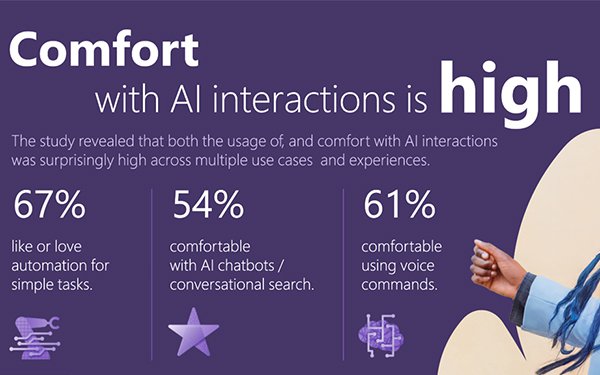
Sixty-seven percent of consumers are very favorable or favorable to automation for simple tasks, 54% are comfortable with AI chatbots and
conversational search, and 61% are comfortable with voice and audible commands.
Microsoft found that in 30% of households with five or more smartphone devices, consumers are eager to use the
technology, but have higher expectations.
Consumers have some concerns. The data found that consumers have concerns about data and loss of privacy controls, and about 45% are concerned about
misunderstanding preferences.
Between 22% and 31% expect AI web experiences today, but the percentage will double in the next six to 12 months, growing from 44% to 52%.
Microsoft said
advertisers will need to ensure they give consumers better experiences. This is where the future is headed. Certain categories -- such as groceries, apparel, health and fitness, and travel and
financial services -- will require more, and were highlighted under the main categories.
Marketers need to think about how they optimize for agents and to build systems -- not just campaigns
-- and design for the present, not just page views. They will also need to think about this shift in terms of how it will impact customers.