Marketers and finance teams often
misunderstand each other with regard to money and performance, even with marketing-mix modeling (MMM).
Only 10.9% of marketers participating in a study acknowledged that they are very aligned
with their company’s finance team, whereas 26.7% indicated they are aligned, according to survey results from Recast, a company supporting marketing, measurement and optimization.
The
study reflects that the numbers marketers work with are difficult to understand -- finding that 40.6% say that in their companies, marketing and finance are only somewhat aligned. Nearly 18% said they
are not aligned, while 4% were not sure.
The study found that CFOs are uneasy with marketing’s reliance on estimates over exact figures, making finance teams skeptical of single,
risk-free projections.
advertisement
advertisement
Factors such as attribution errors, market changes, and unpredictable consumer behavior can cause outcomes to vary from $60,000 to $100,000, while finance prefers
definitive numbers.
Recast released the data from The Recast Marketing Measurement Survey after polling 101 marketing and finance professionals.
When asked whether Recast uses
artificial intelligence (AI) and large language models (LLMs) to support MMM formats, Recast cofounder Michael Kaminsky said the company does not rely on AI. It uses some forms of AI, but not all and
not always.
Kaminsky called LLMs an “optimistic analyst” because the technology looks for the story that it thinks the person wants to tell.
“It often will
construct a story the person wants to see, even if it’s not supported by the data,” Kaminsky said. “LLMs can struggle when the person doesn’t have the knowledge to protest.
When the person does question the LLM, it will sometimes say, 'hey, oh yes, I made that up'."
Communicating uncertainty is important, rather than report false numbers, Kaminsky said, because
"marketing leadership teams do themselves a disservice by offering up false precision when they really do not know."
Many CMOs do not have a financial background, which may make them feel
uneasy, but MMMs can help ease the stress.
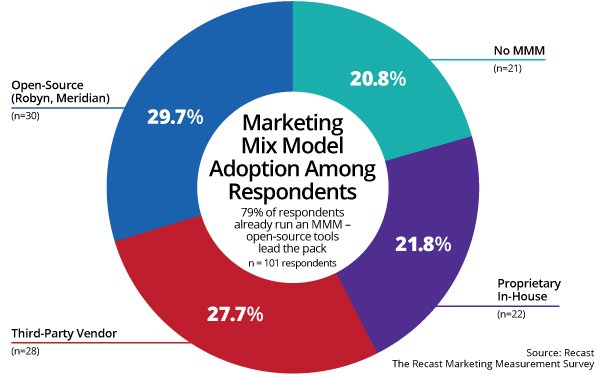
Among the participants in the Recast survey, 29.7% use the open source MMM Meta Platform’s Robyn or Google’s Meridian, and nearly 28% use
a third-party vendor, while 21.8% use a proprietary in-house platform, and 20.8% do not use any MMM.
The study found that among companies that spend more than $50 million annually on paid
media, 58% of senior leaders reported that their marketing and finance teams are not well aligned on measurement methodology.
The data showed that organizational friction and poor
cross-functional collaboration continue to undermine decision-making, particularly at companies with large media budgets.
The study found that 74% of teams running incrementality tests
reported that they avoided cuts, secured more spend, or both.
Most marketers still report results as single point estimates, and few communicate uncertainty or ranges. This creates friction
with finance teams that think in terms of risk.
A point estimate refers to a single numerical value used as the "best guess" for an uncertain future outcome — such as revenue,
project completion dates, or market growth — even when such simplicity may overlook underlying complexities.
Some 74% ran incrementality tests or lift tests and reported positive budget
outcomes, including avoiding budget cuts, securing additional funding, or both.
The study found that budget — which accounts for only 34% — and measurement challenges —
which account for 57% — were not major reasons to avoid internal blockers to experimentation.
The main reason to avoid using a MMM, at 62%, is organizational
willingness. This indicates whether a company’s employees want to use the technology and requires openness to uncertainty, as well as motivation and commitment.