Twenty-six percent of companies received
more than half their traffic from AI search in 2025 -- and 49% expect to reach that mark by late 2026, according to findings released today.
AI Search as a percentage of website traffic is
growing more rapidly than traditional search, jumping from 35% to 50%.
Yet by the end of this year, enterprise leaders in survey results told Branch they still believe the percentage
of website traffic from traditional SEO will keep growing. They expect it to grow eight percentage points, from about 45% to about 53%.
Search marketers and advertisers face major challenges
in the see-sawing now taking place between traditional and AI-related search.
Research released today from Branch -- AI Search and Discovery: Enterprise Benchmark Report -- highlights and
addresses these challenges. The mobile measurement, attribution, and deep-linking services for businesses support companies like Lowe's, PUMA and Sephora.
advertisement
advertisement
"We’re so early and
still defining problems as we try to solve them," Christine Park, chief transformation officer at Branch, told MediaPost. "The data shows it clearly, with only 3% of leaders report negative
impact, 65% are already committing over a quarter of their budget, and yet nearly 80% are struggling with fundamental measurement challenges."
AI already drives results, but operating models
have not caught up, she said. Leaders may feel confident because they can see outcomes, but are not yet able to explain the full journey for campaigns and projects, she added.
About 87% of
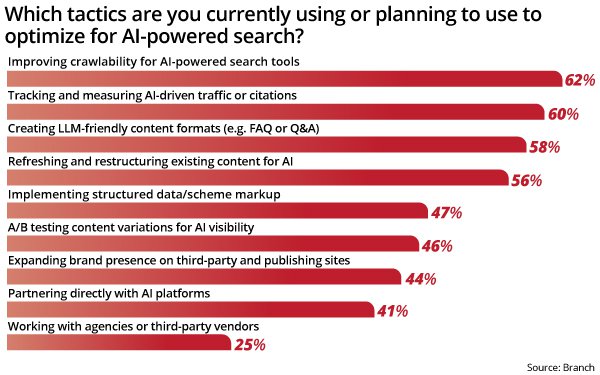
leaders expect AI platforms to close sales this year, but only 41% partner directly with AI platforms and just 25% work with external vendors on AI-powered search, Park said.
Executives
believe, but underestimate, what it takes to support an organization using tech advancements.
"AI isn’t a tooling shift, it’s a human one," Park explained. "Leaders are betting on
outcomes faster than their organizations build the infrastructure to support them.
The opportunity is not only in closing sales inside AI like agentic commerce -- it involves redesigning how
people, processes, and tools come together to support that shift.
The investments required continue to drive shifts in budget. One healthcare data and analytics leader told Branch it requires
a much larger online footprint, which means it will need to significantly invest in AI-driven discovery as well as traditional online discovery.
Investments will become substantial. Eighty-one
percent of companies participating in the study said they optimize for AI search, and another 17% plan to start within the next 12 months.
Sixty-two percent of budgets will go toward improving
crawlability, with 60% toward tracking and measuring AI-driven traffic, 58% toward creating LLM-friendly content formats, and 58% to keep content for AI summaries up to date.
In 2025, AI
search moved from promising to proven, with 89% of enterprise leaders saying it improved their marketing performance. Thirty-five percent saw significant improvement as performance increased by 10% or
more, and 54% saw slight improvement as performance increased by less than 10%.