Commentary

Omnicom Launches Frequency Probe, Finds 'Negative Reach'


As part of a longer-term research project to understand what constitutes optimum ad frequency in today's multimedia, multimodal world, Omnicom's OM Intelligence unit this morning published the first in a series of reports finding that excessive frequency actually produces "negative reach," a phenomenon that happens "when a consumer has seen your ad so many times that it become egregious, beginning to create negative brand recognition."

The report, "Why Frequency Matters," also finds that there no longer are industry rules of thumb for determining when ad frequency generates positive or negative reach, and that it all comes down to the nature of the campaign, the consumer and the media environment, as well as the creative rotation.

advertisement

advertisement

Or, as Chief Intelligence Officer Joanna O'Connell puts it, "it depends."

In a preview of the report's findings, O'Connell said the initial study combined a proprietary consumer research study fielded by OM Intelligence in August 2025, as well as some quantitative research utilizing VideoAmp's ACR data, and programmatic bid stream data from The Trade Desk.

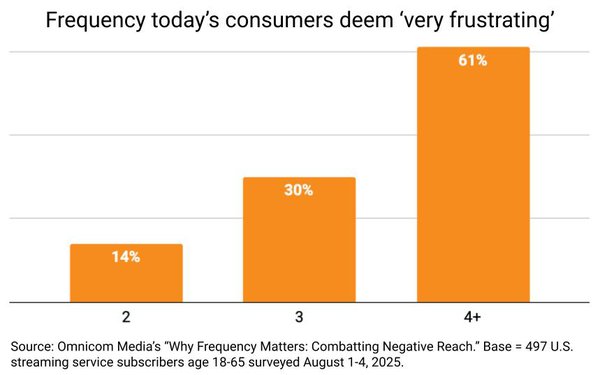
The main initial takeaway is that "negative reach" can occur among some viewers with just two ad exposures of the same ad, but that it occurs among nearly two-thirds of viewers when it approaches frequencies of 4+.

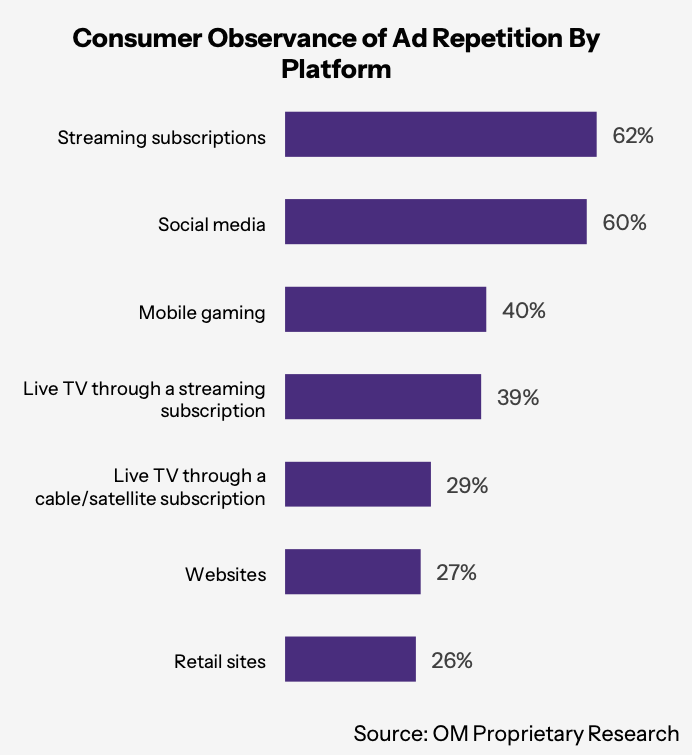
Not surprisingly, the study also found that consumers perceive "negative reach" levels most when seeing excessive ad frequency on streaming platforms, as well as social media platforms -- but interestingly have much more positive reach perceptions when seeing ad frequencies on linear TV, websites and retail sites (see data below).
4 comments about "Omnicom Launches Frequency Probe, Finds 'Negative Reach'".
Check to receive email when comments are posted.
  1. Joel Rubinson from Rubinson Partners, Inc., April 20, 2026 at 12:29 p.m.

    I do not buy into this.  frequency over what time period?  how does that relate to recency theory (the late Erwin Ephron) which I have determined in experiments with Viant and NCS increases ad response by 2-3 x. Frequency is needed to probabilisticly dliver an ad proximal to an upcoming purchase. How about Movable Middles vs "Dead zone" brand rejectors? do they have the same frequency response curves? as Einstein said, "It is important to make things as simple as possible but no simpler".

  2. Ed Papazian from Media Dynamics Inc, April 20, 2026 at 12:49 p.m.

    Joel, Erwin's theory was based on a misreading of a study by Professor Jones which measured the supposed share of market sales effects of household --not viewer--reach for TV campaigns over a week for an arbitrary sample of packeged goods brands. From this  Erwin concluded that the ideal TV media plan should attain a 70% reach but a 1.0 frequency every week  adding  the famous quote, "Frequency is grabgrass". Amazingly this has been quoted ever since by people who seem to think that it meant that frerquency should be avoided --which makes no sense at all. Of course, its less desirable to pile up your frequency so the consumer is exposed many times in a short time frame, but aside from that, without frequency you have no ad campaign.

  3. Curtis Smith from Klick Health, April 20, 2026 at 3:10 p.m.

    This is not really about effective frequency, and more about repeititve frequency within a couple platforms in a very short time period. It's people being annoyed by same CTV ad running 3,4,5x within the same program or within a short period of time (an hour). Same with Social where retargeting ads hitting you every time you open the ap. 4x in one program is different than 4x in a week.

  4. John Grono from GAP Research, April 20, 2026 at 6:06 p.m.

    Spot on Curtis.   The repetitive frequency degrades the product ... and also degrades the quality of the broadcaster's product.   No wonder viewing is declining.

Next story loading loading..