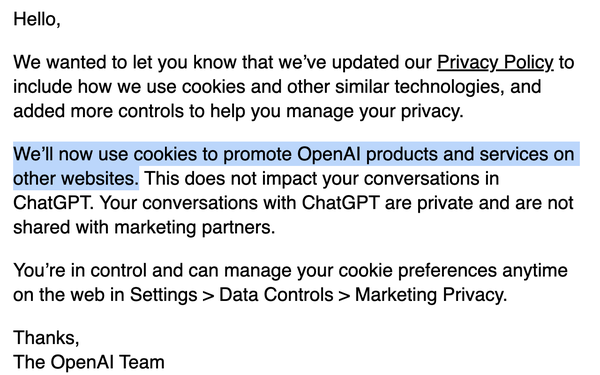
OpenAI has begun to use browser
“cookies to promote OpenAI products and services on other websites,” the company wrote in an email sent to users on Friday explaining the policy changes in the U.S.
The shift moves OpenAI beyond organic growth to a commercialized advertising and marketing strategy.
An action like this identifies the company's readiness to transition from being a research-led organization to a competitive consumer brand that uses standard ad technology to find and convert
users.
Cookies with small text files will be placed on the user’s device when interacting with OpenAI services. They also help users remember details about user visits, such as preferred
language. When users are logged in, cookies can improve the user experience on subsequent visits.
advertisement
advertisement
The updated privacy policy clarifies that it does not impact ChatGPT conversations, which
remain private. "This Privacy Policy does not apply to content that we process on behalf of customers of our business offerings, such as our API. Our use of that data is governed by our customer
agreements covering access to and use of those offerings," according to the blog post.
The update provides details on the type of data it collects and how it is used. For example, for
Free and Go users, the data will help to personalize the ads seen on its Services, subject to user settings, and will help measure the effectiveness of ads shown on the Services.
Brands and users can manage their marketing cookie preferences through their OpenAI account settings or a link
on the website footer when not logged in.
OpenAI also will use third-party cookies on its site, which originate from a domain that is different from the current site visit.
Similar
technologies -- such as pixels, web beacons, sharing of device IDs and other identifiers via APIs or local storage -- can be used for these purposes. For simplicity, OpenAI refers to these
technologies as “cookies” in its Cookie Policy.
OpenAI explains in the post how cookies are required to operate OpenAI services like authenticating users or group for security
purposes.
“Marketing tracking today becomes behavioral profiling tomorrow,” Lucio Ribeiro, chief AI innovations officer at TBWA Australia, wrote in a post on LinkedIn. Riberio
posted an Australian version.
Ribeiro made a video on
how to switch it off, whereas the Claude AI community on Facebook mocked OpenAI’s change.