No, my headline isn't a typo. It was just a way to pique
your interest about, well, "peak TV."
It's a term that has had many definitions since the inception of
the medium:
- A synonym for its "Golden Age"
- And perhaps most famously, AMC Networks' analytics about the rise -- and ultimately saturation and decline of -- the
supply of scripted TV series content.
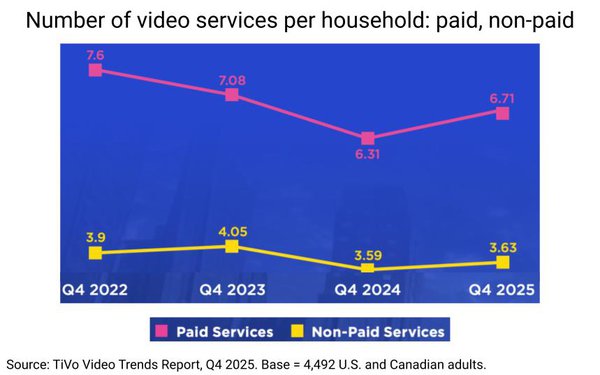
And now there's a new meaning, according to new research released late last week by legacy TV tech brand TiVo: peak levels of television
engagement.
The finding is not necessarily empirical, but based on responses to the most recent edition of its quarterly consumer surveys, covering the fourth quarter of 2025, which polled
4,493 adults in the U.S. and Canada.
advertisement
advertisement
It found that despite economic pressures, the average household returned to a peak of 10-plus video services and their average viewing peaked above five
hours daily -- levels that TiVo says the medium has not had since 2021.
That's just a peek at the findings. You can read the whole report here.
But I'd like to end by pointing out something the study doesn't
necessarily highlight, but definitely implies in terms of yet another TV industry peak: fragmentation.
Original scripted series, subscriptions to video services and other metrics aside, the
medium is now so hyper-fragmented in terms of sources of video content that even industry pros often struggle to come up with a single word to describe what the medium actually is.
"Viewing
patterns are increasingly fragmented," the report finds, noting that SVOD now constitutes 27% of total viewing time, and AVOD/FAST usage expanded to 13%, signaling a shift toward lower-cost and free
alternatives.
"Local content and live sports continue to serve as foundational anchors, with local programming comprising almost 30% of total viewing time—an increase of nearly five
points year-over-year—and 59% of sports viewers primarily relying on Pay TV, affirming its strategic importance," it continues.