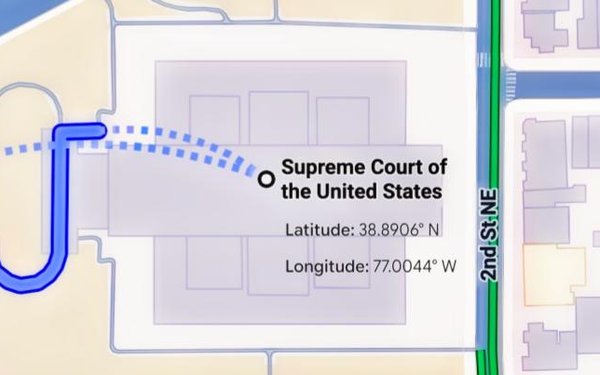
In a decision
hailed by privacy advocates, the Supreme Court ruled 5-4 Monday that people have a "reasonable expectation of privacy" in
records about their cell phone's location data.
"Location History resembles other private materials -- think of emails, documents, photographs, or calendars -- that even if stored on
Google’s servers, a user reasonably views as his own," Justice Elena Kagan wrote for the majority. "And as a result, that he reasonably expects to be shielded from the 'inquisitive eyes' of the
government."
The ruling came in a dispute over law enforcement's
ability to collect geolocation data to investigate crime, but advocates say the court's rationale likely has "broad implications" for a host of data.
advertisement
advertisement
The court "recognized the
records generated by the apps on a user’s phone -- records we necessarily share with third-party tech company -- are a user’s 'own' and require Fourth Amendment protection," digital rights
group Electronic Frontier Foundation said Monday in a blog post about the decision.
"This will likely have broad implications for data generated by other apps on our phones,
even if we click 'agree' to sharing that data with third-party tech companies," the group added.
The group Electronic Privacy Information Center likewise praised the ruling.
"As technology’s surveillance capabilities continue to expand, today’s decision preserves a basic principle of a free society: people should not have to sacrifice their
privacy simply to participate in modern life," the organization stated.
The group Electronic Privacy Information Center likewise celebrated the decision.
"As
technology’s surveillance capabilities continue to expand, today’s decision preserves a basic principle of a free society: people should not have to sacrifice their privacy simply to
participate in modern life," the organization stated.
Monday's ruling grew out of the criminal prosecution of Okello Chatrie, who was accused of the 2019 gunpoint robbery of a
bank in Midlothian, Virginia.
To investigate, police officers served Google with a "reverse location" warrant -- meaning a warrant for information about all Google account
holders who were physically near the bank when the robbery occurred.
Google provided the information, which eventually led the police to Chatrie. (Google subsequently stopped
storing location information on its servers; the company said in a friend-of-the-court brief that it "can no longer respond to geofence warrants based on Location History data.")
Chatrie sought to suppress evidence resulting from that warrant, arguing that the police violated his Fourth Amendment right to be free from unreasonable searches and seizures.
The government opposed Chatrie's request for several reasons. Among other arguments, prosecutors said Chatrie had no expectation of privacy in location data he shared with Google.
Kagan specifically rejected the argument that people ceded a privacy interest in location data by sharing it with Google.
"The point of carrying smartphones
is to use what is on them," she wrote. A cell-phone user is not to be viewed as sharing private information with third parties -- which then can be freely passed on to the government -- just by doing
the ordinary things cell-phone users do."
The ruling sent the case back to a lower court for further proceedings.
While the decision dealt with a criminal defendant's
4th Amendment rights, the Supreme Court's reasoning could affect judicial rulings in privacy battles between web users and tech companies, according to Sara Geoghegan, senior counsel at the Electronic
Privacy Information Center.
"The Supreme Court's understanding of privacy interests is influential," Geoghegan tells MediaPost, adding that the Supreme Court's view "can be
hugely informative to courts thinking about different claims."
The decision comes around three months after Senator Ron Wyden (D-Oregon) renewed his call for the proposed Government Surveillance Reform Act, which would generally require federal personnel to obtain a warrant before acquiring people's location data, web browsing history,
internet search history and other information.
Lawmakers including Wyden have also sponsored the Fourth Amendment Is Not For Sale Act, which would require federal law
enforcement and intelligence agencies to obtain a court order before buying personal information from data brokers, and also prohibit government agencies from purchasing data obtained through
deception or violations of a privacy policy.
The House passed the bill last year, but the Senate has not.
The ad industry group Network Advertising
Initiative supported that bill, as did more than 40 advocacy organizations including the Center for Democracy & Technology, Electronic Frontier Foundation and Free Press.