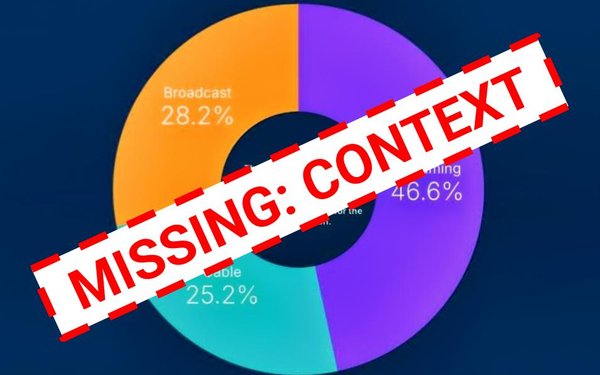
Published data for Nielsen-measured total ad-supported TV viewing for
the first quarter of 2026 needs more “accurate representation,” according to The Television Bureau of Advertising (TVB)
Specifically, the TV station advertising trade group, which
represents the broadcast TV industry, believes that the streaming share of ad-supported results is higher than what it should be. “While the reported 46.6% streaming share sounds significant, it
is missing key context,” says a TVB press release.
One major key area, according to TVB, are lower broadband-only universe estimates coming from Advertising Research Foundation’s
DASH study that are not being factored into current monthly and quarterly published Nielsen Gauge and Media Distributor Index.
“Higher broadband-only penetration estimates could inflate
streaming’s audience and undercount linear audiences,” the TVB says.
advertisement
advertisement
Nielsen says its published data will see an official update to incorporate DASH-related universe estimates
starting in September.
Industry observers have been wondering why Nielsen is waiting to make the changes official for its published data when it agreed to new DASH estimates in February
2026.
Nielsen says: “This is significant because this approach, while consistent with previous months of the Gauge, will have different results than production data."
"Production
data" refers to data that clients can pull themselves which include the DASH universe updates.
The TVB also has an issue with Nielsen looking at the broader viewers two years and older
audience, saying: “[It is] a population that includes children and teenagers who are not consumers in key advertising categories. When this same methodology is applied to adults 18+, linear
television’s share increases while streaming’s share decreases.”
The TVB also notes that YouTube can account for as much as one-third or more of streaming’s
ad-supported viewing in the Gauge.
But it also says YouTube’s content is not on the same level as legacy TV content “because YouTube’s content is primarily user-generated and
shorter form."