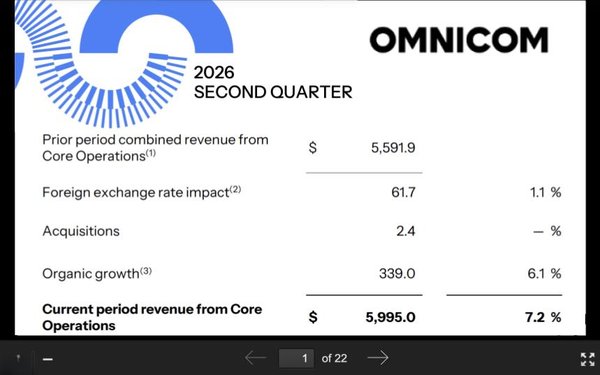
Omnicom reported organic growth of 6.1% on revenue from core
operations of $6.0 billion in the second quarter.
Those core operations exclude subsidiaries that the firm plans to sell or
otherwise dispose of.
But the organic revenue figure that Omnicom reports is based on gross revenue that does not exclude pass-through costs such as those related to
principal-based trading, which competitors like Publicis and WPP provide.
advertisement
advertisement
And according to calculations by media and marketing consultant Madison And Wall, Omnicom's net organic revenue for the
quarter declined by 2%.
Here's Madison And Wall's's logic: "We note that third-party service costs of $1.75 billion during 2Q26 compares to non-pro forma combined
third-party costs of $1.47 billion during 2Q25. Presuming 15% of the pass-throughs in 2Q25 came out of the cost base of the business with dispositions, the like-for-like / pro forma third-party
pass-through cost for 2Q25 was closer to $1.25 billion. This implies that around $500 million of revenue growth was due to pass-throughs."
Thus, says M&W, "the organic revenue 'growth'
of 6.1% equated to a gain of only $339 million from all sources including pass-throughs, implying that comparable net revenues fell by around -2% on an organic basis."
During an investor call
Tuesday afternoon, company CEO John Wren said the company was raising its gross organic growth guidance for the full year from 4% to between 4.5% and 5%.
The company’s
integrated media operations (accounting for about 52.5% of company revenues) generated $3.1 billion, which the company said was up 10%-plus on an organic basis as the company defines it.
Integrated media is an expanded discipline resulting from the merger reorganization that includes data, commerce and digital transformation consulting.
Revenue from the
company's advertising division was down in the high single digits.
The U.S. region — accounting for 60% of revenue — posted high single-digit revenue growth.
The company said it
is on track to achieve $900 million cost synergy savings this year.
The firm is in the process of selling what it termed low growth assets generating between $3.5 and $3.6 billion revenues on an
annualized basis.
Companies accounting for about $2 billion of that amount were disposed of in the first seven months of the year. Companies accounting for another $525 million will be sold by
the end of the year, the firm said.
Wren said on the call that organic growth was achieved by both new business wins and expanded remits of existing clients.
Looking ahead, Wren
said agentic marketing transformation would be a major focus for the company, as will "newer consumer engagement models" such as sports and entertainment, commerce and AI-driven search. Bringing new
services to existing clients will also be a priority.
"Our second quarter results reflect the momentum of the new Omnicom," Wren stated.
Company shares were up over
4% Tuesday, but dipped in after-hours trading.