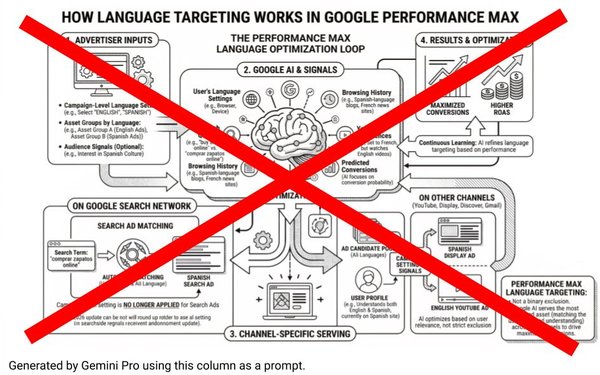
Campaign-level language
targeting will disappear from Google Search and Performance Max campaigns starting in late September.
The ad platform will also begin to favor the advertisements and landing pages with the
language that matches the search term.
This means that if someone searches for something in German, the advertising platform will give higher priority to ads and websites that are also written
in German.
"The system takes into account ad creative and landing language," Ginny Marvin, ads product liaison at Google, told MediaPost. "There's no change to how we use user
signals such as language preferences. With this update, the system will also use enhanced ad group prioritization to select the most relevant ad language based on the user’s search context when
there are multiple eligible campaigns or ad groups."
advertisement
advertisement
The post details what will change and how it will impact campaigns. For many things it will have no impact -- such as language
exclusions, which are already not supported. Leaving a language unselected does not mean it will be excluded.
"As language targeting has evolved, the campaign-level setting has become
redundant, Marvin wrote in a LinkedIn post. "The system already understands and handles language automatically, looking at an array of signals including the language of the ad creative and landing
page, search term language and the user’s language settings and preferences."
Manual language targeting was first made available by Google in 2001 for up to 14 languages as part of
its early push to globalize the self-service ad platform.
'The company did not confirm, but Google is likely to eliminate this feature because artificial intelligence (AI) and
automation are able to detect the language of choice by the person reading or interacting with the ad and content.
Ad creative and text customization in AI Max will not change. Google
does not translate ad creative.
Reporting will not change, and ads matching to different languages when the user understands the ad or landing page language will not change. And
there will be no change for those advertisers using single-language campaigns such as English or Spanish.
Marvin wrote that the feature has lost its function and cited friction as
a reason the feature is being eliminated.
Now the system will prioritize ads that match the language that the user’s search term matches -- one feature that is changing.
"When you
have multiple eligible campaigns or ad groups in different languages within your account, we’ll now use our existing AI-driven ad and asset group prioritization to identify and select the most
relevant ad language based on the user's search context," Marvin wrote.
Marvin provided an example. For multilingual users, AI-driven ad groups will prioritize and identify
the most relevant ad based on the users’ specific context and language preference at auction time.
"When users are traveling in a different country, the system primarily
relies on the user’s language preferences, which remain consistent when they travel," Marvin wrote.
There is no need to restructure campaigns, but Marvin suggested that
advertisers should review campaigns to ensure the ad creative and landing pages are clearly structured in the advertiser's intended languages for users.
"We also recommend
to stop including language criteria in new and updated Search campaigns when sending Google Ads API requests," she wrote. "For existing campaigns, you may remove language targeting for hygiene
purposes. The setting will no longer apply."