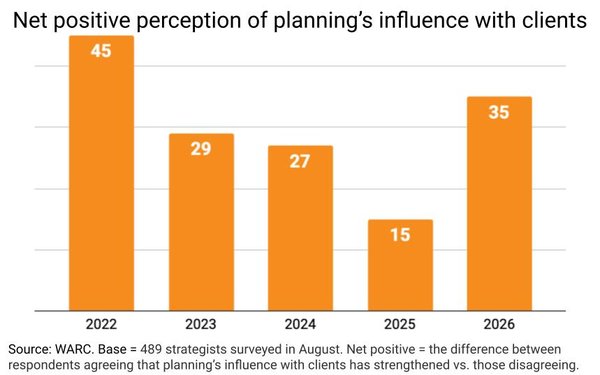
After eroding for several years, perceptions of planning's
influence with clients improved dramatically this year, according to findings of a global study of nearly 500 strategists -- mostly from ad agencies -- conducted by WARC in August.
After
falling to a net positive score -- the difference between those saying it has strengthened vs. those indicating it has weakened -- of 15, the net positive score rebounded to 35 this year.
While that is still below a net positive score of 45 in 2022 -- the benchmark finding published in WARC's just-released "The Future of Strategy 2026" report -- it nonetheless comes at a time when
other factors have been contributing to marginalize the role of planning, including:
- The flight of
senior talent
- The rise of AI, especially the so-called "two-audience problem" requiring marketing to communicate simultaneously to people in conventional ways, as well as to AI
platforms and agents in machine-readable ones.
advertisement
advertisement
“As growth gets harder to find, strategists are moving upstream, beyond the brief and into the questions that matter most to
CMOs,” explains WARC Strategy Content Director Lena Roland.
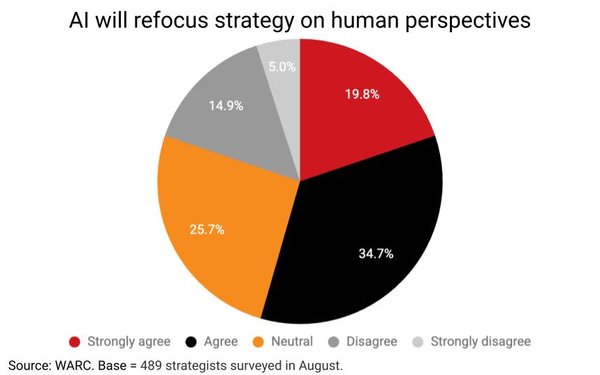
Interestingly, the report also found a majority believe AI will refocus the industry on human perspectives, but there was no
baseline to show whether that is increasing or decreasing.
Also, it's not clear whether WARC also surveyed the other side of the "two-audience problem" or just the human respondents to its
research.
Based on presentations I covered last week during the Association of National Advertisers AI conference -- especially Shelly Palmer's presentation projecting AI agents will comprise 99.9% of all digital
traffic within 26 months -- I'm not so sanguine about the focus on human perspectives.
In other words, the real "two audience problem" is that humans will only comprise 0.1% of the
audience digital marketers will be talking to.