Marketers, app
developers and publishers saw consumers spending more money on mobile apps in 2025, according to a new report from app intelligence company Appfigures, with revenue up 21% year-over-year despite app
downloads dropping for the fifth year in a row.
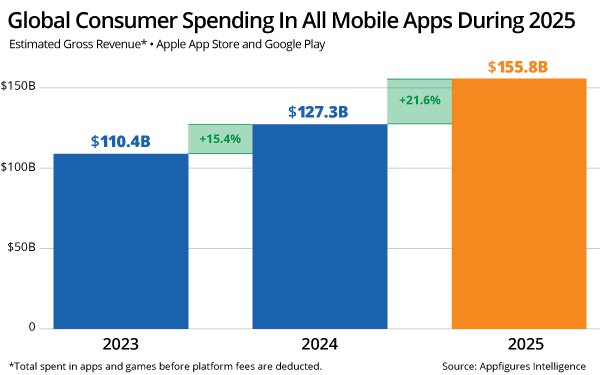
Last year, consumers across the globe spent almost $156 billion on
mobile apps. They invested more in app subscription costs, in-app purchases and initial download costs, marking a $29 billion increase from 2024 and a $46 billion boost compared to 2023.
Consumer spending on mobile apps in the U.S. rose 18% year-over-year to $55.5 billion, with non-gaming apps holding the top spot with a 27% boost ($33.6 billion)
compared to gaming app spending, which hit $22 billion for the year, marking a 7% increase.
advertisement
advertisement
Globally, gaming apps were responsible for 46% of the total mobile app revenue
($72.2 billion), seeing a 10% increase year-over-year, while non-gaming apps saw a much steeper revenue boost at 34%, reaching $82.6 billion in 2025, per Appfigures’ findings.
However, app downloads hit 107 billion globally last year -- a 2.7% decrease compared to 2024.
The
report shows downloads falling consistently ever since a peak in 2020, when 135 billion apps were downloaded by consumers as the COVID-19 pandemic impacted the amount of time people spent on their
devices.
While gaming apps and non-gaming apps saw increases in revenue, mobile games downloads fell almost 9%
compared to 2024, as 1.1% more people downloaded non-game apps in 2025 compared to the previous year.
Overall, subscription models are transforming the mobile app economy because they rely less on individual downloads and user numbers than consistent payments and the
sale of special branded in-app offerings.
According to another report, almost 96% of app
spending in the Apple App Store and Google Play Store is derived directly from subscriptions, with app subscription retention hitting 20% for monthly and 41% for annual plans, whereas
weekly subscription plans contributed 46% of all app revenue on the Apple App Store, according to Adapty.