
Commentary

CIMM Finds Market Can Financially Support Two Ad Currencies

The Advertising Research Foundation's Coalition for Innovative Media Measurement (CIMM) this morning unveiled findings of months-long marketplace assessment for the economic viability of multiple new advertising currencies and determined there's room for just two.

The finding should not come as much of a surprise, for a couple of reasons.

One, that's what its authors -- audience measurement research veterans Josh Chasin and Manish Bhatia -- predicted when they announced the initiative at the CIMM East summit in the spring of 2025.

And two, that has been the historic precedent for ad-market currencies in the past.

Remember Arbitron vs. Nielsen in local broadcast measurement? Or MRI and Simmons in magazine audience measurement?

advertisement

advertisement

Or Nielsen versus any number of fill-in-the-blank players attempting to dethrone it in national TV audience measurement (see AGB, ScanAmerica, R.D. Percy, SMART TV, for starters)?

I'm not sure what the imperative was to conduct a new, contemporary economic assessment, but it probably has something to do with the fact that there is an overabundance of alternative currencies vying to dethrone -- or at least compete with -- Nielsen as the dominant ad industry currency.

I mean, there already are three alternatives to Nielsen -- Comscore, iSpot and VideoAmp -- certified by the so-called JIC organized by OpenAP.

Assuming no one else joins what the new CIMM report oddly calls the "the fiesta," that makes four possible national "cross-platform" advertising currencies in a market the experts say can only support two, financially.

(I think the study's "fiesta" terminology emanated from a quip at the CIMM East summit and regular MediaPost op-ed contributor Tony Jarvis' follow up column about it.)

Read the report to understand the economics of a two-ad currency supply chain, but what I'm most interested in is not what the market will bear for currency providers, but what the presence of two viable currencies have on the supply and demand of the advertising marketplace.

I was just a cub ad trade reporter when Arbitron's numbers competed with Nielsen's in local media markets, or when publishers and agencies would haggle over the differing methods of MRI and Simmons, but I seem to recall there was a significant amount of marketplace confusion, or what economists would call "information asymmetry" because of it.

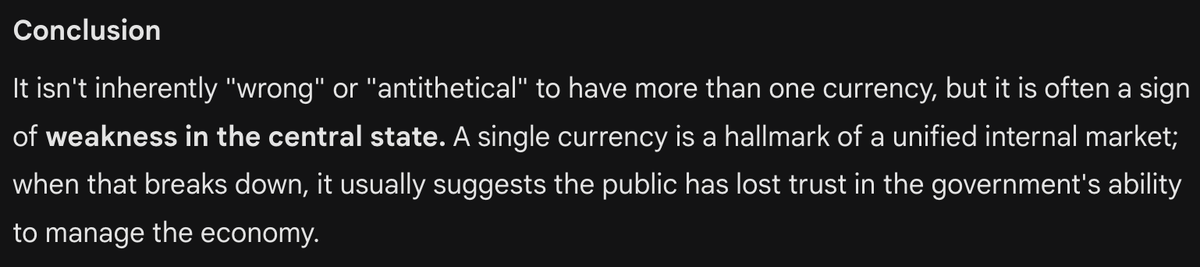
Just for the heck of it, I asked a couple of LLMs how common it is for the coexistence of economic currencies across the world's nations, and while it isn't that uncommon or "antithetical," the conclusion is it sends a signal of "weakness in the central state," because the public loses trust in the government's ability to manage its economy.

Not sure how that applies to industries, but if you ask me, it's the greatest reason why the U.S. ad industry should have a genuine JIC -- joint industry committee representing advertisers, agencies and the media -- setting the standards and sourcing its currency from the best supplier competing for the right to manage it. You know, how it works in much of the rest of the world's advertising markets.

9 comments about "CIMM Finds Market Can Financially Support Two Ad Currencies".
Check to receive email when comments are posted.
  1. M Cohen from marshall cohen associates, January 22, 2026 at 9:59 a.m.

    So which "two" will it be? Place your bets.

  2. Steve Sternberg from The Sternberg Report, January 22, 2026 at 11:42 a.m.

    Let's not forget that the reason Arbitron went away was because the idustry decided it didn't want to pay for two essentially identical local TV Measurement services.  The reason AGB and others failed was also because the industry didn't want to pay for two national meaasurement services.  Sellers won't want another national currency unless it provides higher ratings than Nielsen.  Buyers won't want one unless it provides substantially more types of data than Nielsen.

  3. M Cohen from marshall cohen associates, January 22, 2026 at 12:56 p.m.

    One of the things that we were attracted to with AGB (I signed us up -- MTV Networks) was that they had a much more collaberative way of working with their clients. They truly listened to us and our concerns.

  4. Ed Papazian from Media Dynamics Inc, January 22, 2026 at 1:08 p.m.

    It's important to understand what happened in the past in TV when there were two "currencies". First and foremost they were all purporting to measure the same thing--audience. Not different things--like audience versus liking or interest in ads. Second, each of the ad agencies settled on one or the other of the two alternatives for local market TV, not both. This created a situation whereby stations had to subscribe to both services so they could sell time to all of the agencies--a very expensive situation. 

    Fast forward to national TV/CTV and I gather that CIMM is saying that the industry can support two competing audience measurement services--with both claiming to measure exactly the same thing--audience--- plus whatever additional refinements they might offer. But the standard "currency" would be audience. Which  means that, as before in local market TV, the agencies and their clients would settle on one of the contenders as their basic--or "standard"--- source, leaving the sellers to buy both.Ldet's face it, Nielsen will win in most of these decisions as the incumbent of long standing. I don't think that most sellers will jump with delight at the prospect of supporting both services when one is used for almost all of the buys. 

    As I point out in my soon-to-be released book about TV, "TV Yesterday, Today and Tomorrow", the basic reason why nobody has unseated Nielsen in past attempts is that no proof has been offered to indicate that its findings are significantly faulty. Consequently, a rival service struggles fitflly to sustain itself against Nielsen--especially if it is producing essentially the same findings. Even when the rival cuts its prices--as has been offered in past challenges---to get its foot in the door, the offer is refused as the sellers dare not make  a cold turkey switch away from Nielsen. Suppose the newbie screws up and fails to supply the needed data. Horrors! So they would be stuck with buying both services for two or three years--pending decisions by the buying community as to which service they want.

    How would such decisions be made? Simple. If one of the two rating services consistently shows slightly larger audiences, but otherwise there were no differences--especially in terms of the respective shares of audience among the various sellers--- many agencies would favor the service with the lower ratings as  this works to keep CPMs down. Would that be an appealing prospect for the primary funders of the rating services--the sellers? I doubt it.. 

    I'm not against competition, but if you want to unseat Nielsen you are in for a long haul battle and you need deep pockets to absorb the inevitable red ink. I seriously doubt that a rival service could capture more than 10% of the business by merely being available--without showing that Nielsen is getting it all wrong.

  5. Ed Papazian from Media Dynamics Inc, January 22, 2026 at 3:25 p.m.

    Regarding a JIC being set up in the U.S. to decide what is the best TV rating service for national--and local--TV--why not. However a true JIC has active involvement by sellers buyers ( agencies ) and advertisers, it can not be dominated by the sellers. Also, if the sellers pay 80% of the costs for the  selected U.S. rating service monopoly and it's  run as a business it will, of necessity be far more responsive to the wishes of its primary funders--the sellers. In other words you get an inbalance of power that favors the sellers. Or will advertisers be willing to pay a fair share so they have a real say?

    While there are JICs in other countries in many of them they have endorsed basically a people meter panel as the preferred methodology, employing fairly small numbers of homes--not the big data approach for set usage that Nielsen has been presured into adopting in the U.S.. So, unless alternative ways to view "TV" content are lacking in those countries and ratings aren't fragmenting they are well behind the times re the need for larger sample sizes--even if all members of their JICs agree that what they have is best. 

  6. Joshua Chasin from KnotSimpler, January 22, 2026 at 3:43 p.m.

    Yes, Joe. The "fiesta" in question is the "multi-currency fiesta," as the marketplace was dubbed by Fox's Kym Frank at an early CIMM 2025 event.

  7. Ed Papazian from Media Dynamics Inc, January 22, 2026 at 3:45 p.m.

    Joe, re magazine research there were many competitors The Nielsen Media Service ( NMS ) , The Brand Rating Index ( BRI ), Simmons, The Target Group Index (TGI ) and, later, MRI founded by TGI's Timothy Joyce. Also, Politz tried belatedly to get in on the action. However these companies used different methodologies which produced very differrent audience estimates. MRI eventually won out because its method gave publishers mich larger audience estimates than  Simmons and MRI was able to measure hundreds of small circulation magazines that the Simmons methodology couldn't handle. 

  8. Jack Wakshlag from Media Strategy, Research & Analytics replied, January 22, 2026 at 4:20 p.m.

    From the perspective of a media seller, paying for more than one currency makes no sense unless there were buyers who chose a second one that we would be forced to buy to do business with them.  It is a currency. Is there any other business where buyers and sellers use more than one?  Not that I know of. Currencies (Euros vs dollars for example) may differ but there is always a set exchange rate so it doesn't matter. In addition as each currency provider provides reasons to fault the other, the credibility of both suffer. As far as one side preferring higher ratings vs the other, that all fades away as we have learned when transitioning from diaries to meters to people meters etc.

    Multiple media currencies never really worked. That's why they went away.  

  9. Ed Papazian from Media Dynamics Inc, January 22, 2026 at 4:39 p.m.

    Jack, having just read the report, what theyare actually saying is that using more than one metric as currency is the goal--even if thre is no consistency from one seller to the next re which metrics --or combinations of metrics--are the "currency" of the buy. So it's not just about encouraging other companies to compete with Nielsen--which is fine with me--it's the old multiple currency gambit that they seem to be advocating--with everybody doing their "thing" as we legacy types used to say in the 1960s. 

Next story loading loading..