Advertising executives travel frequently from
coast to coast and around the world, hardly pausing as long as they are able to connect with brand clients.
A Google and American Airlines trial using artificial intelligence (AI) and
analyzing thousands of flights between the U.S. and Europe has found that planes produce fewer contrails if they follow flight paths recommended by AI to reduce the impact on global warming.
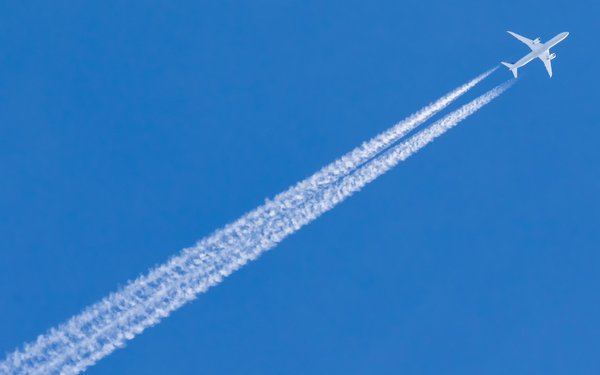
Contrails, seen as white streaks behind planes, are streaks of condensation seen in the sky following a plane's path, and are known to disrupt the environment.
Triggered by soot particles
produced by aircraft engines, contrails are believed to cause more warming than the carbon dioxide that planes emit.
The emissions form ice crystals from water vapor in airplane engine
exhaust, mixing with naturally occurring particles in cold, humid atmospheric conditions at high altitudes.
advertisement
advertisement
Contrails only form in very specific humid parts of the sky. Google used AI and
satellite data to map the "moist zones" so planes could fly slightly above or below them to keep the sky clear.
Contrails act as a blanket, trapping heat on Earth. They are responsible for
about 35% of aviation's total global warming impact.
While the joint research has little to do with online advertising, the trial is primarily a
sustainability initiative that can significantly impact how both companies market their environmental efforts and services.
It also could impact which airlines ad industry executives use to
travel around the world to support brands.
Google worked with American Airlines and the Breakthrough Energy group to develop the AI technology.
A randomized
control trial demonstrated that integrating contrail forecasts into standard flight planning allows dispatchers to reduce contrail formation, with a 62% reduction in contrail formation for flights
following the avoidance protocol.
The trial observed an overall 11.6% reduction in contrail formation for all participating flights without a statistically significant increase in fuel
usage.
In early March, the European industry association for the digital marketing and advertising ecosystem IAB Europe released its fourth annual State of Readiness - Sustainability in Digital
Advertising Report, which highlights the digital ad ecosystem’s progress in its environmental and social sustainability efforts.
IAB Europe conducted the survey between November 2025 and
January 2026, gathering 135 responses from companies and associations active across European markets.
There were notable findings, and those focused on environmental concerns include
measurement.
The proportion of companies estimating environmental impact across all campaigns has doubled from 2025 to 2026, and environmental actions consistently outpace social actions.
Carbon reduction levers are more widely adopted than social impact measures, according to the report.
One substantial change is that 32% of survey respondents have not and do not plan to
publish sustainability reports, illustrating uneven readiness across the ecosystem, per the report.
Regulatory drivers have shifted sustainability from voluntary to a legal and operational
obligation.