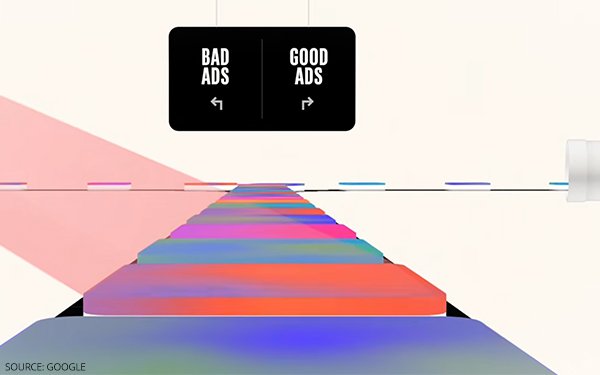
Google removed 1.7 billion ads and suspended
3.3 million advertiser accounts in the U.S. in 2025, the company reported.
The most common violations were abusing the ad network, misrepresentation, sexual content, personalization
violations, and dating and companionship ads.
Gemini, Google’s AI models, now analyzes billions of signals, such as account age, behavioral cues, and campaign patterns, to identify
potential threats. The company is making AI a core part of enforcing ads because it has helped to catch more scams while reducing mistaken suspensions of legitimate advertisers.
In its 2025
Ads Safety Report, Google stated it blocked or removed 8.3 billion ads and suspended 24.9 million advertiser accounts last year. More than 99% of policy-violating ads were stopped before they ran,
according to the blog post author Keerat Sharma, VP & GM of ads privacy and safety at Google.
advertisement
advertisement
“Bad actors are using generative AI to create deceptive ads at scale, and Gemini helps
us detect and block them in real time,&rdquo Sharma wrote. “By the end of last year, the majority of Responsive Search Ads created in Google Ads were reviewed instantly, and harmful content
was blocked at submission — a capability we plan to bring to more ad formats this year.”
Gemini also cut incorrect advertiser suspensions by 80% by processing 4x more user reports
than the year before. It managed to spot scam signals faster by better understanding ad intent.
Google said it removed 602 million scam-related ads and suspended 4 million scam-linked accounts.
AI has become the watchdog for advertising through AI and
agentic technology and behavioral analysis. Through agentic technology and behavioral analysis, AI protects brand integrity and consumer trust as AI continues to rewrite the inner workings of the internet.
Anthropic’s Project
Glasswing initiative that brings together Amazon Web Services, Anthropic, Apple, Broadcom, Cisco, CrowdStrike, Google, JPMorganChase, Linux Foundation, Microsoft, NVIDIA, and Palo Alto Networks also
has enabled the ability to reduce cyberattacks and glitches in software.
Launched in April 2026, Project Glasswing is a cybersecurity initiative led by Anthropic
through Claude Mythos2, an unreleased AI model that reached a level of coding capability where they can surpass skilled humans at finding and exploiting software vulnerabilities, according to the
company.