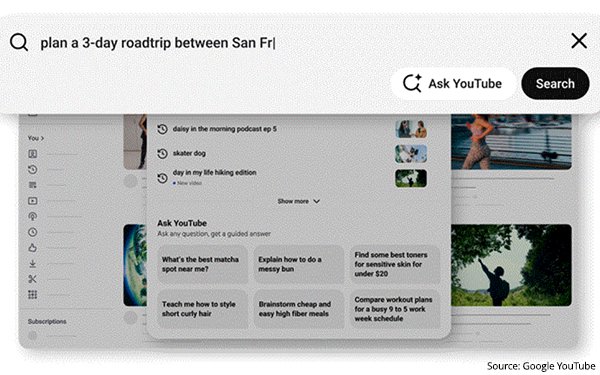
An experimental feature announced in YouTube Labs
enables site visitors to ask complex questions and receive multimodal results that include video and text.
Some might consider the test, "Ask YouTube," to be a more sophisticated version of a
feature introduced in 2023.
The test, announced today, enables the user to search on a deeper level and across YouTube using artificial intelligence (AI). It acts like an AI chatbot in
YouTube, providing deeper, interactive insights into the topics in the videos, rather than just listing videos.
"We’re experimenting with a new way to search on YouTube that feels
more like a conversation," the blog post states.
Users can enter a prompt into the search bar, such as “plan a 3-day road trip between San Francisco and Santa Barbara” and
select 'Ask YouTube' to get results. Follow-up questions or select suggested prompts allow users to explore in more detail.
The feature is available now in English on desktop for Premium
users age 18 and up in the U.S. through June 8.
The version, tested in 2023, was designed as an engagement tool. It worked as an in-video chat to help users understand one video,
while the 2026 "Ask YouTube" is designed as a conversational AI tool to search the entire YouTube platform.
advertisement
advertisement
The placement of the "Ask button" in 2023 was located below the video
player and designed to analyze the transcript and visuals of one video, whereas the "Ask YouTube" button is integrated into the main search bar on YouTube and is designed to synthesize information
from multiple videos and shorts.
The platform being tested now has a custom response page with AI text, cited videos, and relevant timestamps.
It feels like an extension of
AI-based search features being integrated into Google Search and many of its advertising platforms, from Performance Max to Shopping Ads and Google Analytics 360.
While Google
continues to experiment with "Ask YouTube" for Premium users, the company has integrated its underlying AI capabilities into the broader advertising ecosystem.If the feature
turns into a tool for all, advertisers could target users based on full conversational queries rather than keywords.
For example, if a user asks "How do I plan a 3-day road trip
to Santa Barbara?" brands can appear within the AI-generated text
summaries or as cited video
results.
"Ask YouTube" does not yet have dedicated, stand-alone targeting controls or reporting, so advertisers cannot use it today to target ads based on queries. However,
a user's conversational query in Ask YouTube has commercial intent. Google's other platforms may automatically insert relevant ads into the experience.
Advertisers that are eligible for these placements must
run either AI Max &
Performance Max, Broad Match
Keywords, or Broad Match
Keywords, according to a quick search on Google AI Mode.