After half a century covering the media
marketplace, I thought I had seen every conceivable model for funding ad-supported media buys. Until I met Piyush Puri.
Barter. Reciprocal trade. Time bank credits. Commissions. Rebates.
Principal. But "media-for-equity?"
The truth is, the model used by Mercurius Media Capital -- the media-for-equity funding company Puri and his partner Satyan Gajwani founded with backing
from The Times of India Group in 2023 -- is not entirely news.
It has been used for years in international markets -- especially in Europe -- but it is relatively new in the U.S., which
represents nearly half of worldwide ad spending. And it's gaining traction, including some big legacy media companies.
And this week, MMC announced a $25 million, five-year deal with A+E
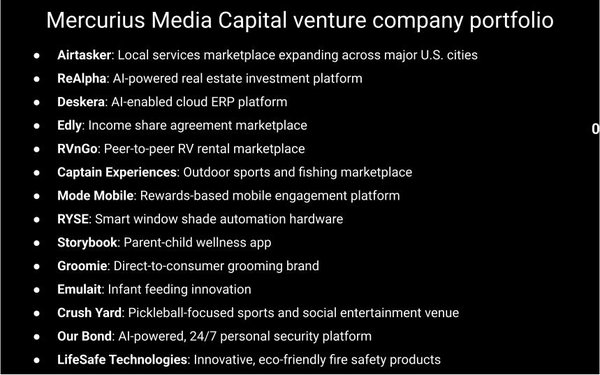
Networks providing upward of $5 million in advertising inventory each year to MMC's portfolio of promising startup companies (see below).
advertisement
advertisement
Here's how it works.
Ad-supported media
companies like A+E function essentially as investors in venture capital equity funds, but instead of cash, they contribute unsold advertising inventory, which is then allocated to the portfolio
companies to grow their businesses.
Instead of receiving cash up front, the media company investors get a share of the venture fund's equity and when that fund "exits" by monetizing the equity
built up by the portfolio's startups, it is paid back to the media companies like any other capital investor -- ideally with a profitable return on top of their original equity investment value.
To date, MMC has raised $30 million in media "capital" investments, including the A&E deal, as well as smaller investments from legacy TV, as well as CTV, FAST and place-based media companies
including:
Puri says the interest among legacy media companies -- especially TV-oriented ones -- makes sense for both those
companies, as well as MMC's startup portfolio.
For the legacy media, it's a way to offset declining share of the advertising marketplace, monetizing unsold inventory, and taking a rider on
potentially valuable equity payouts.
More importantly, he says, it brings them incremental ad demand from small and medium-sized startups that likely would not otherwise be in a position to
buy "top-of-the-funnel" TV-centric advertising.
As for the early-to-mid-stage portfolio companies, the awareness-building TV ad inventory represents an opportunity to move past conventional
startup "performance" media to generate broader awareness and differentiate themselves from competitors.
But that's not where MMC's media-for-equity funding model ends.
It also has
expanded into advertising services, including research, strategy, media planning and buying/allocation via a second pool of investors: ad agencies.
While MMC has its own in-house planning and
buying arm, dubbed "Brand Strategy," to help the startups determine and negotiate the vest pool of ad inventory from the media company investors -- yes, that inventory is negotiated along with the
rest of the media companies' open market inventory -- MMC has also brought media agency service companies in as equity investors.
But instead of allocating media inventory credits as
"capital," the agencies invest their planning, buying, strategy and research services in exchange for shares in the fund's pool and are paid off like media company investors when the fund exits.
To date, MMC has struck advertising services investments from agencies including Aletheia and WITHIN, but already is exploring diversifying further into -- and up and down -- the advertising
and marketing services supply chain, including influencers in the "creator economy," as well as their agencies.
“We are essentially doing this now under a model called
'influencer capital,'" Puri shares, noting that the model already is a growing concern among influencers -- big and small -- who are treating their reach like capital. He cites a recent equity
portfolio investment fund created by tennis star and mega influencer Roger Federer.
“We are building a pool of influencers and agencies that represent these influencers who
will give us their reach and we’ll monetize it by turning it into equity," Puri explains, adding that as big as MMC's vision and roadmap are, its goal is to walk before it runs, and right now it
is gaining traction with high-profile legacy media companies, which is right on its target.
"We see a bigger opportunity for 'attention capital,' because increasingly [ad] impressions are not
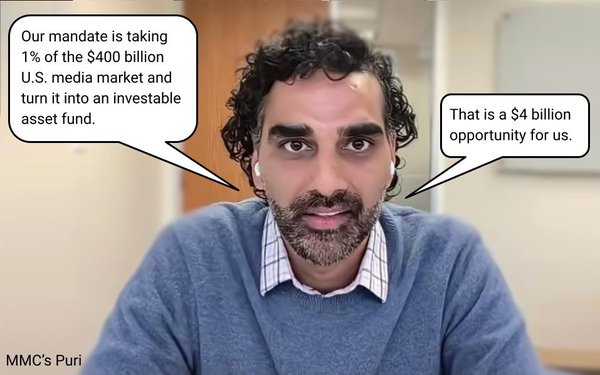
sufficient," he says, adding: "Our mandate is taking 1% of the $400 billion U.S. media market and turn it into an investable asset fund. That is a $4 billion opportunity for us."