More than ever for this TV upfront
market, brands and media-buying and media-planning executives are focused on one critical factor: real returns on their media spend.
Nearly 50% (45.5%) of respondents to a recent iSpot survey
say it is all about business outcomes.
Farther down on the list is verified ad delivery, with 28.5% pointing to that.
"Outcomes" are listed at the most "significant challenges for
linear and streaming,” at 46.5%, and audience is the next-biggest "challenge" at around 38%.
"Creative" issues registered at 20%, followed by the "efficiency" of a TV/streaming buy at
14.5% and finally, program ratings at 9.0%.
The research goes on to say that 47.5% of marketers expect upfront budgets to remain the same compared to the previous year -- up from 35% heading
into the upfront market a year ago.
advertisement
advertisement
But this "same" budget allocation comes at the expense of linear TV, with a major shift to social video media and CTV/streaming.
Increasingly,
premium TV streaming video content is being combined with social video media, with 24% of respondents saying half of their TV/streaming ads also are placed on social video, while 39% say social video
share will comprise more than half of overall media plans.
More broadly speaking, over 50% of marketers see the rising share of video budgets going to social video and streaming/national CTV
platforms, as national linear and local TV media investments remain the same.
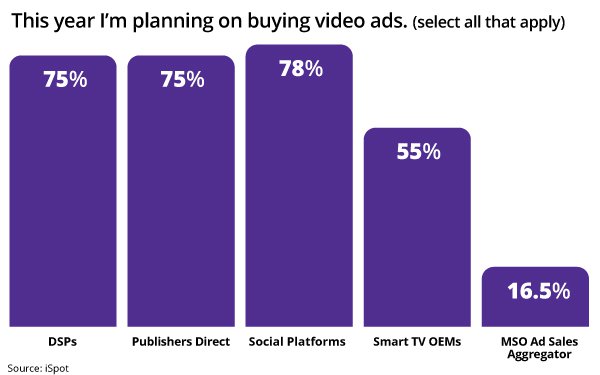
Increasingly, brands are buying video through alternative methods.
Seventy-five percent say they will buy
through publisher-direct platforms, while 78% are planning to buy video ads through social platforms such as YouTube, 75% through DSPs (demand-side platforms); 55% through smart TV operating
system platforms, and 16.5% through multiple system operator (MSO) ad sales aggregators.
The research was conducted with over 200 brand, advertiser, and media agency executives surveyed from
March 25, 2026 to April 27, 2026.